
Everything about
NRI GIFT City Investment
Build your global portfolio through GIFT City
Explore professionally guided investment opportunities through GIFT City’s globally connected financial ecosystem, with solutions designed for NRIs to diversify portfolios and support long-term wealth creation.
Legacy
Clients
Clientele
Management (INR)
Members
GIFT City Investment Solutions for NRIs
What is GIFT City Investment Solutions?
GIFT City, or Gujarat International Finance Tec-City, is India’s International Financial Services Centre (IFSC), designed to facilitate international financial services and investment activities through a dedicated regulatory framework. For eligible NRIs, HNIs, family offices, and global investors, GIFT IFSC can provide access to professionally managed investment structures across India-focused and international markets, including Alternative Investment Funds (AIFs) and other permitted financial products. For NRIs, this can be a more attractive investment option due to its tax-free benefits.
How we make GIFT City Investment Solutions work better for you?
At Ashutosh Financial Services, we help investors understand GIFT IFSC opportunities in the context of their financial goals, risk profile, investment requirements, and existing portfolio. Our approach considers eligibility, investment structure, strategy, taxation, costs, liquidity, currency exposure, and applicable regulatory requirements, helping investors evaluate GIFT City opportunities with greater clarity before making investment decisions.

What is a GIFT City Fund for NRIs?
A GIFT City Fund for NRIs is an investment fund established in Gujarat’s GIFT International Financial Services Centre (GIFT IFSC), India’s international financial services hub regulated by the International Financial Services Centres Authority (IFSCA). These funds provide eligible NRIs access to professionally managed investment opportunities across Indian and international markets. Depending on the fund’s objectives and structure, investments may include listed securities, private equity, venture capital, real estate, infrastructure, debt, and other permitted asset classes, offering opportunities to diversify beyond traditional investments.
GIFT City funds may suit NRIs seeking professional investment management and portfolio diversification. However, eligibility, minimum investments, taxation, fees, liquidity, currency exposure, and risks vary by fund. IFSCA has also introduced regulatory measures concerning NRI and OCI participation in certain IFSC-based funds investing in Indian securities. Before investing, NRIs should review the fund’s offer documents and understand the applicable tax and regulatory requirements in India and their country of residence. Consulting qualified financial, tax, and legal professionals can help ensure investment decisions align with their financial goals, risk profile, and investment horizon.
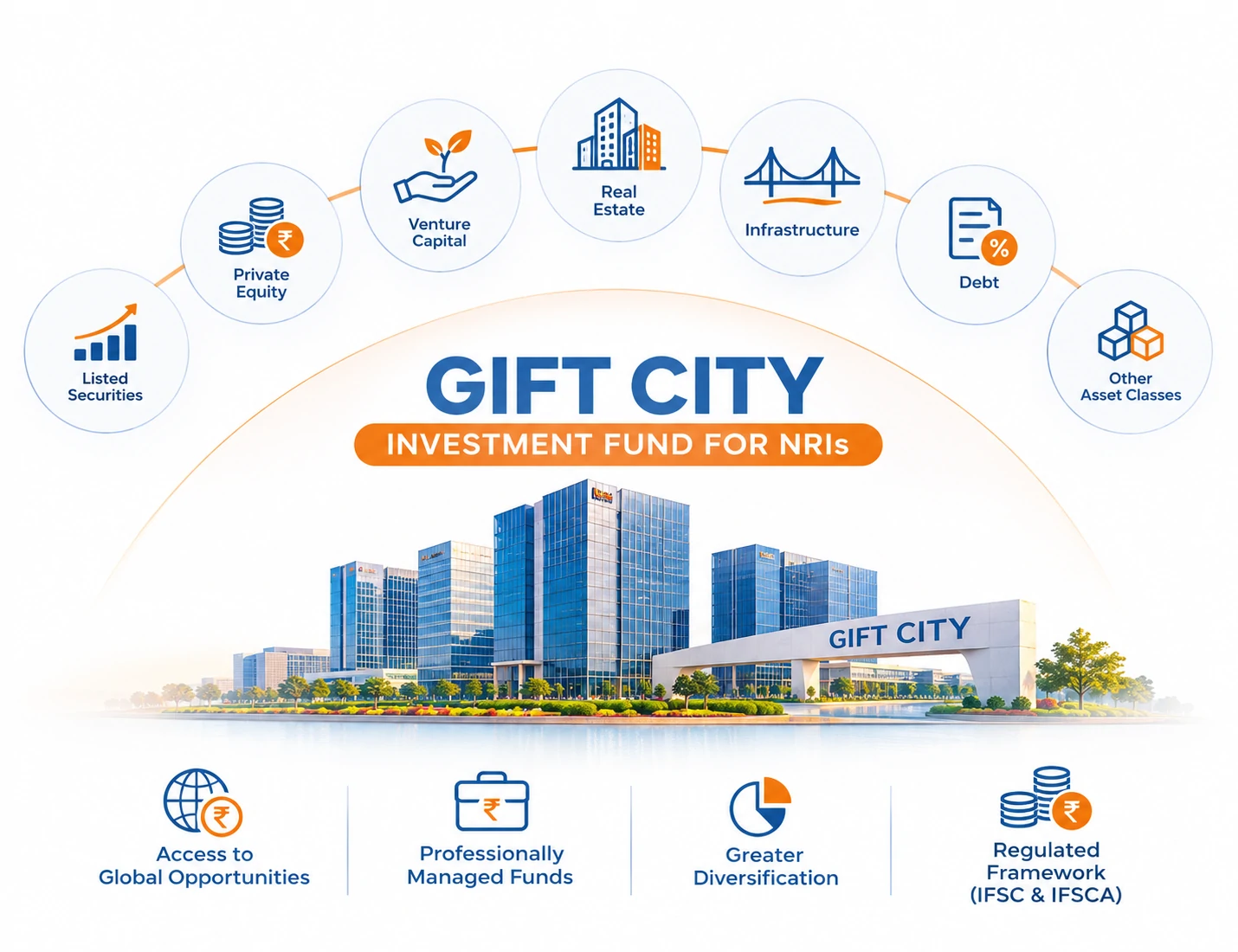
Process of GIFT City Alternative Investment Fund (AIF)
The process of setting up an Alternative Investment Fund (AIF) in GIFT City involves selecting the appropriate fund structure, establishing the fund management entity, and obtaining the necessary registration and approvals from the International Financial Services Centres Authority (IFSCA). Once approved, the fund can onboard investors, complete the required compliance and documentation, and commence investment activities in accordance with the applicable regulatory framework.
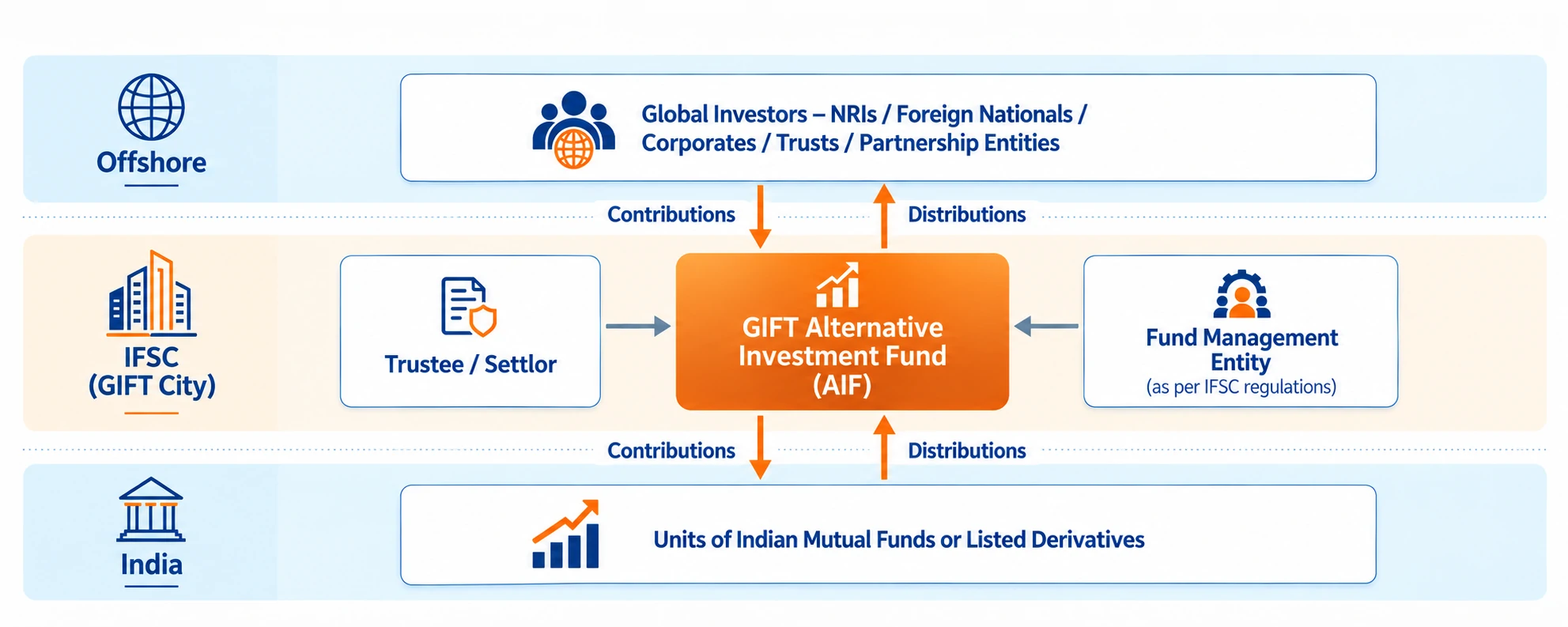
- Global Investor Identification: Global investors, including NRIs, foreign nationals, overseas corporates, trusts, and partnership entities, identify a suitable AIF established in GIFT City IFSC. They review the fund’s investment strategy, risk profile, minimum investment, fees, and exit conditions before investing.
- Investor Onboarding and Compliance: The investor completes KYC, beneficial ownership verification, source-of-funds checks, and applicable tax declarations. The fund verifies investor eligibility and completes the necessary documentation under the applicable regulatory framework.
- Capital Contribution to the AIF: The investor remits the subscription amount to the designated fund or scheme account in accordance with the applicable banking and foreign-exchange requirements. The fund records the contribution and issues the relevant units or evidence of participation under its governing documents.
- Investment in Indian Financial Instruments: The AIF invests the contributed capital according to its approved investment strategy and applicable IFSCA regulations. Investments may include eligible Indian mutual fund units, listed derivatives, or other permitted instruments, depending on the scheme’s mandate. The Fund Management Entity monitors investment performance and portfolio risks.
- Returns and Distribution Calculation: The fund’s investments may generate income, capital gains, or losses depending on market conditions. The fund calculates distributable proceeds after considering applicable management fees, expenses, and other charges. Investor entitlements are determined according to the fund’s governing documents and distribution policy.
- Distribution and Repatriation to Investors: The AIF distributes eligible income, realized gains, or returned capital to investors in accordance with the scheme’s terms. Payments are subject to applicable taxes, withholding requirements, and foreign-exchange regulations. Investors receive the net proceeds through the designated payment arrangements, subject to any fund-specific exit or liquidity restrictions.
Types of GIFT City Funds
GIFT City offers different types of investment funds designed to meet the needs of NRIs, HNIs, family offices, and global investors. Depending on the fund structure and investment strategy, investors may get exposure to different asset classes, investment markets, and geographical regions. These funds can provide opportunities to invest in Indian equities, global equities, hybrid investments, and debt instruments through the GIFT City framework. The choice of fund should be based on the investor’s financial objectives, risk profile, investment horizon, liquidity requirements, and existing portfolio, along with an understanding of applicable regulations, taxation, currency risks, and other investment considerations.

- Retail India Equity Funds: Retail India Equity Funds are designed for investors who want to participate in the Indian equity market through a relatively lower investment amount. These funds provide exposure to Indian equity mutual funds and can help investors access professionally managed equity portfolios through the GIFT City framework. The suitability of these funds depends on the investor’s financial objectives, risk profile, and investment horizon.
Exposure: These funds provide exposure to Indian Equity Mutual Funds.Minimum Investment: The minimum investment amount is USD 500.
- Retail Global Equity Funds: Retail Global Equity Funds provide investors with an opportunity to gain exposure to international markets through Global ETFs and Stocks. These funds can help investors diversify beyond the Indian market and participate in global companies and market opportunities. Investors should consider factors such as market risk, currency movements, country-specific risks, and their overall portfolio before investing.
Exposure: These funds provide exposure to Global ETFs and Stocks.
Minimum Investment: The minimum investment amount is USD 5,000. - India Equity Funds: India Equity Funds are intended for investors seeking higher exposure to the Indian equity market through Indian Equity Mutual Funds and Stocks. These funds can provide a broader approach to investing in Indian companies and equity-oriented opportunities through the GIFT City framework. Investors should evaluate their investment objectives, risk tolerance, and long-term investment horizon before considering such funds.
Exposure: These funds provide exposure to Indian Equity Mutual Funds and Stocks.
Minimum Investment: The minimum investment amount is USD 150,000. - Global Equity Funds: Global Equity Funds provide exposure to international investment opportunities through Global ETFs and Stocks. They can help investors diversify their portfolios across different countries, companies, and economic sectors rather than relying only on the Indian market. Global equity investments are subject to market, currency, country, regulatory, and geopolitical risks, which should be considered before investing.
Exposure: These funds provide exposure to Global ETFs and Stocks.
Minimum Investment: The minimum investment amount is USD 150,000. - Hybrid Funds: Hybrid Funds combine exposure to different investment categories and, as shown in the reference, provide exposure to Indian Hybrid Mutual Funds. This approach may help investors seek a balance between different asset classes within a single investment structure. The suitability of a hybrid fund depends on its underlying allocation, the investor’s risk profile, financial objectives, and investment horizon.
Exposure: These funds provide exposure to Indian Hybrid Mutual Funds.
Minimum Investment: The minimum investment amount is USD 150,000. - Debt Funds: Debt Funds provide exposure to debt-oriented investments through Global Debt ETFs. These funds may be considered by investors looking to include global fixed-income exposure as part of their overall portfolio. Investors should assess interest-rate risk, credit risk, currency risk, market conditions, and the fund’s underlying investments before making an investment decision.
Exposure: These funds provide exposure to Global Debt ETFs.
Minimum Investment: The minimum investment amount is USD 150,000.Note: The minimum investment amounts and fund availability may vary by fund and applicable GIFT City/IFSC regulations. Investors should review the specific fund’s documents, eligibility requirements, risks, costs, and applicable regulations before investing.
Our Expertise in GIFT City Funds for NRIs
For NRIs, investing in India can involve several important factors, not just choosing an investment product. Things like your country of residence, FEMA rules, taxes, currency and how you want to use your money can all matter. Our expertise in GIFT City funds helps NRIs understand these factors and explore investment options that may suit their financial goals and needs.
- Presence in GIFT City: Our office presence in GIFT City, Gandhinagar, gives us a better understanding of the GIFT IFSC investment environment.
- Data-driven analysis: We study fund performance, investment strategy, portfolio, risk, costs and other important factors before evaluating an opportunity.
- Investment and regulatory understanding: We combine our investment knowledge with an understanding of FEMA, exchange control regulations and applicable taxation.
- Case-by-case approach: We assess each investor based on their country of residence, financial profile, risk appetite, liquidity needs and investment objectives.
- Experience with global investors: We have experience supporting investors from different countries in evaluating and onboarding into suitable GIFT IFSC fund opportunities.
- End-to-end guidance: We assist investors through the evaluation and selection process, while considering the relevant investment, tax and regulatory aspects.
Advantages for NRIs Through the GIFT City Fund
GIFT City funds offer Non-Resident Indians (NRIs) an opportunity to access India-focused investment options through an internationally regulated financial ecosystem, with potential benefits such as portfolio diversification and streamlined cross-border investments. Depending on the fund structure and applicable regulations, these funds may also offer tax efficiencies, operational flexibility, and convenient access to India’s growth opportunities.
- Potential Indian Tax Benefits: Eligible NRIs may benefit from tax exemptions or favourable tax treatment, subject to applicable tax laws and fund structure.
- Tax Benefits on Investments: Certain gains from investments in Indian mutual fund units or derivatives may receive favourable tax treatment, depending on the fund structure and applicable regulations.
- No PAN Requirement in Certain Cases: NRIs may not need an Indian PAN for certain fund investments, subject to applicable rules and requirements.
- No Indian Tax Return Filing in Certain Cases: Filing an Indian income tax return may not be required if the applicable legal conditions are met.
- Reduced Tax Assessment Formalities: Eligible investments may involve fewer Indian tax formalities, depending on the investor’s circumstances.
- No Need for an Indian Demat or Broking Account: NRIs can invest through the fund without directly opening an Indian demat or broking account to hold the underlying securities.
- No Need to Open an Indian Bank Account for the Investment: Funds can generally be transferred from an eligible overseas bank account to the GIFT City fund, subject to its payment procedures and applicable regulations.
- USD-Denominated Investments: Investors can access funds that accept investments in US dollars, helping them invest without first converting their money into Indian rupees.
- Competitive Currency Conversion: The fund may offer competitive foreign exchange conversion rates when investing in underlying Indian mutual fund units.
- Simplified Onboarding: The investment process can be more convenient, with a streamlined account-opening procedure.
- Easy Documentation and KYC: The fund’s onboarding and Know Your Customer (KYC) process may be simpler than investing directly in Indian securities.
What Is IFSCA (International Financial Services Centres Authority)?
The International Financial Services Centres Authority (IFSCA) is the unified regulator for the International Financial Services Centre (IFSC) at GIFT City. It brings together the relevant regulatory powers of four major Indian financial regulators: RBI, SEBI, IRDAI and PFRDA for applicable financial activities within the IFSC.
Each regulator has a specific role in India’s financial system. Under the unified IFSC framework, IFSCA oversees the relevant activities of these sectors within GIFT City.
- RBI – Reserve Bank of India: RBI regulates banking activities, manages monetary policy and supports financial stability in India. Within GIFT City IFSC, the relevant regulatory functions relating to international banking and permitted banking services fall under IFSCA’s framework.
- SEBI – Securities and Exchange Board of India: SEBI regulates India’s securities markets and protects investors’ interests. Within GIFT City IFSC, IFSCA oversees applicable capital market activities, securities-related services, exchanges and investment fund activities.
- IRDAI – Insurance Regulatory and Development Authority of India: IRDAI regulates the insurance sector in India, including insurers and insurance intermediaries. Within GIFT City IFSC, IFSCA oversees permitted insurance and reinsurance activities and related financial services.
- PFRDA – Pension Fund Regulatory and Development Authority: PFRDA regulates pension systems and pension fund activities in India, including the National Pension System. Within GIFT City IFSC, IFSCA oversees applicable pension-related activities and permitted pension fund services.
How does this benefit GIFT City investors?
By bringing these relevant regulatory functions under one authority, GIFT City IFSC provides a unified regulatory framework for a range of international financial activities, including banking, capital markets, investment funds, insurance and pension-related services. For eligible NRIs, HNIs, family offices and global investors, this framework provides access to permitted financial products and services within a dedicated international financial centre. Investment eligibility, regulatory requirements and tax treatment depend on the product, investor category and applicable laws.
Our GIFT City Investment Process
1
Understanding Your Investment Needs
We begin by understanding your country of residence, financial objectives, investment horizon, risk profile, liquidity requirements, currency exposure and existing portfolio.
We consider:
- Financial Goals
- Investment Horizon
- Risk Profile
- Liquidity Needs
- Currency Exposure
- Existing Portfolio
2
Eligibility & Regulatory Assessment
We evaluate whether the proposed GIFT IFSC structure is appropriate based on your investor status, residency, eligibility, documentation and applicable regulatory requirements.
Our assessment considers:
- Investor Status
- Country of Residence
- Eligibility
- Regulatory Requirements
- Tax Considerations
3
Identifying Suitable Opportunities
Our research-led approach evaluates relevant GIFT IFSC funds and investment strategies according to your objectives and portfolio requirements.
Investment universe may include:
- Category I AIFs
- Category II AIFs
- Category III AIFs
- India-Focused Strategies
- Global Strategies
- Equity
- Alternative Investments
4
Recommending the Investment Strategy
We explain the proposed structure, investment rationale, portfolio role, costs, liquidity, tax considerations and key risks.
We provide clarity on:
- Investment Structure
- Investment Rationale
- Portfolio Role
- Costs
- Liquidity
- Tax Considerations
- Key Risks
5
Executing the Investment
Once you decide to proceed, we assist with the applicable onboarding, KYC, documentation, fund subscription and transaction process.
We assist with:
- KYC & Documentation
- Application Process
- Fund Subscription
- Account / Platform Setup
- Fund Transfer
- Investment Execution
6
Monitoring & Portfolio Review
Our relationship continues beyond the initial investment. We periodically review relevant portfolio developments, fund performance, market conditions and changes in your financial objectives.
Our review considers:
- Portfolio Performance
- Fund Developments
- Market Conditions
- Risk & Allocation
- Liquidity
- Rebalancing Requirements
Value-Added Services Without Paying Extra
Individual Service Charges
Other service providers bill you separately for each service, making you pay more at extra costs.

- Income Tax Filings and compliances
- International tax support
- HUF Planning

- Will Planning
- Private Family Trust


Exclusive Benefits with Ashutosh Financial Services
- Income Tax Filings and compliances
- International tax support
- HUF Planning
- Will Planning
- Private Family Trust
Start your financial Journey with us
Achieving financial stability begins with the right advice. Our experienced advisors help you identify suitable investment opportunities, manage risks, and create a clear strategy for long-term financial growth.
Our Valued Partners













Frequently
Asked Questions
Find quick answers to common questions about our services, processes, and financial solutions.
GIFT City, located in Gandhinagar, Gujarat, is India's international financial centre. It provides a platform for various financial and investment services, including investment funds. For NRIs, GIFT City can provide access to investment opportunities with an international financial services framework while being based in India.
Yes, NRIs may be able to invest in GIFT City funds, subject to the eligibility criteria, fund structure and applicable regulations. The requirements can vary between funds, so investors should check the specific fund's terms before investing.
Ashutosh Finserve helps NRIs understand and evaluate GIFT City investment opportunities based on their individual requirements. We look at factors such as the investor's country of residence, financial goals, risk appetite, investment amount, liquidity needs and investment horizon. We also help investors understand the fund structure, relevant FEMA considerations, tax-related questions and the overall onboarding process, so they can make a more informed investment decision.
GIFT City offers different types of investment and financial products. Depending on the fund and its investment strategy, opportunities may include Indian equities, global investments, fixed-income securities, private markets and alternative investments. The available options, risks and eligibility requirements differ from one fund to another.
An NRI should consider the investment objective, risk level, fund strategy, past performance, fees, liquidity, investment horizon, currency exposure, tax implications and applicable regulations. It is important to understand the complete investment structure rather than making a decision based only on expected returns.
No. The suitability of a GIFT City investment depends on an individual's financial goals, risk appetite, investment horizon, liquidity requirements, country of residence and overall financial situation. A fund that may be suitable for one investor may not be suitable for another.
FEMA and related foreign exchange rules may apply to investments involving India and overseas funds. The applicable requirements can depend on the investor's status, source of funds, investment structure and transaction. Since regulations can change and individual circumstances differ, NRIs should obtain appropriate professional advice before investing.
Tax treatment depends on several factors, including the NRI's country of tax residence, type of fund, investment structure, income or gains and applicable tax laws or treaties. Indian tax rules and the rules of the investor's country of residence may both need to be considered. Investors should consult a qualified tax adviser for advice specific to their situation.
Repatriation may be possible, but the process and applicable requirements depend on the fund structure, source of funds, investor status, banking arrangements and relevant regulations. NRIs should understand the applicable repatriation rules before making an investment.
The process generally involves selecting an appropriate fund, checking eligibility, completing KYC and other documentation, arranging the investment funds, completing the fund's onboarding process and making the investment. The exact process varies by fund. Working with an experienced adviser can help make the process easier to understand and manage.
GIFT City, located in Gandhinagar, Gujarat, is India's international financial centre. It provides a platform for various financial and investment services, including investment funds. For NRIs, GIFT City can provide access to investment opportunities with an international financial services framework while being based in India.
Ashutosh Finserve helps NRIs understand and evaluate GIFT City investment opportunities based on their individual requirements. We look at factors such as the investor's country of residence, financial goals, risk appetite, investment amount, liquidity needs and investment horizon. We also help investors understand the fund structure, relevant FEMA considerations, tax-related questions and the overall onboarding process, so they can make a more informed investment decision.
GIFT City offers different types of investment and financial products. Depending on the fund and its investment strategy, opportunities may include Indian equities, global investments, fixed-income securities, private markets and alternative investments. The available options, risks and eligibility requirements differ from one fund to another.
An NRI should consider the investment objective, risk level, fund strategy, past performance, fees, liquidity, investment horizon, currency exposure, tax implications and applicable regulations. It is important to understand the complete investment structure rather than making a decision based only on expected returns.
Yes, NRIs may be able to invest in GIFT City funds, subject to the eligibility criteria, fund structure and applicable regulations. The requirements can vary between funds, so investors should check the specific fund's terms before investing.
No. The suitability of a GIFT City investment depends on an individual's financial goals, risk appetite, investment horizon, liquidity requirements, country of residence and overall financial situation. A fund that may be suitable for one investor may not be suitable for another.
FEMA and related foreign exchange rules may apply to investments involving India and overseas funds. The applicable requirements can depend on the investor's status, source of funds, investment structure and transaction. Since regulations can change and individual circumstances differ, NRIs should obtain appropriate professional advice before investing.
Tax treatment depends on several factors, including the NRI's country of tax residence, type of fund, investment structure, income or gains and applicable tax laws or treaties. Indian tax rules and the rules of the investor's country of residence may both need to be considered. Investors should consult a qualified tax adviser for advice specific to their situation.
Repatriation may be possible, but the process and applicable requirements depend on the fund structure, source of funds, investor status, banking arrangements and relevant regulations. NRIs should understand the applicable repatriation rules before making an investment.
The process generally involves selecting an appropriate fund, checking eligibility, completing KYC and other documentation, arranging the investment funds, completing the fund's onboarding process and making the investment. The exact process varies by fund. Working with an experienced adviser can help make the process easier to understand and manage.