Everything about
Secure Your Future with Smart Fixed Deposit Investments
Make every rupee work steadily with fixed deposits built for stability and long-term security. With Ashutosh Financial Services select Fixed Deposit plans that fit your goals, timeline, and risk comfort.
What is Fixed Deposit?
Fixed Deposits (FDs) are a popular investment option for individuals seeking relatively stable and predictable returns over a predetermined period. By investing a lump sum for a selected tenure, investors can earn interest at the applicable rate, subject to the terms and conditions of the financial institution. FDs can support various financial needs, including short- to medium-term goals, planned expenses, capital preservation, and portfolio diversification. Factors such as interest rates, tenure, liquidity, premature withdrawal conditions, taxation, and the institution’s financial strength are important when evaluating FD options.
How we make Fixed Deposits work better for you?
At Ashutosh Financial Services, we help investors choose Fixed Deposit options that align with their financial goals, investment horizon, liquidity requirements, and overall asset allocation. Our approach emphasizes clarity and informed decision-making by helping you understand applicable interest rates, payout options, maturity values, tax implications, and associated risks. Through personalized guidance, we aim to help you incorporate Fixed Deposits into a well-structured financial plan that supports your financial stability and long-term objectives.

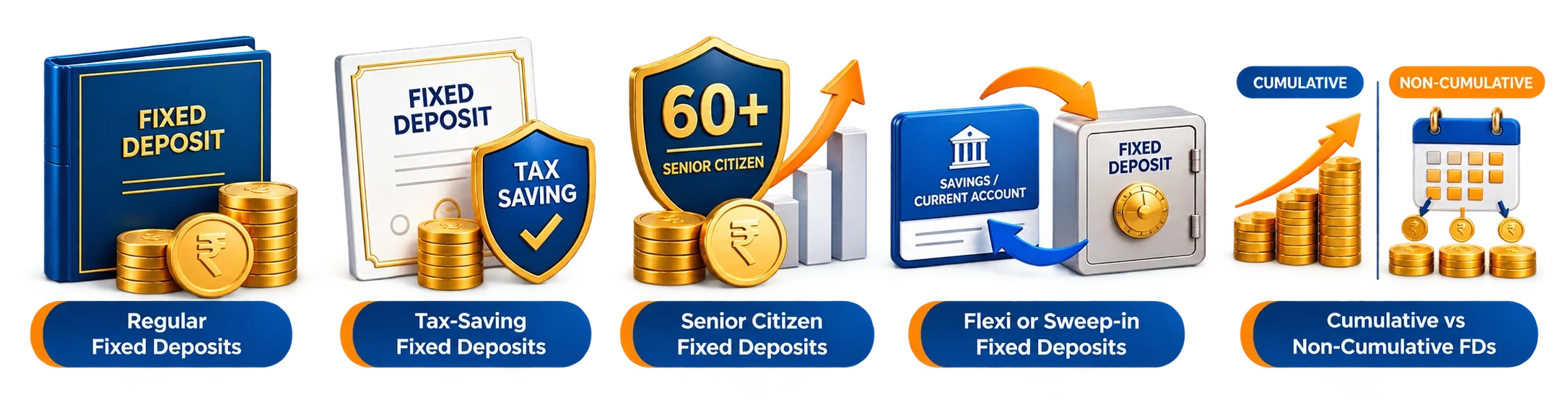
Fixed Deposits are available in different formats to suit varying financial goals, liquidity requirements, and income preferences. From regular and tax-saving FDs to senior citizen and flexi deposits, each type offers distinct features in terms of tenure, interest payouts, accessibility, and tax considerations. Understanding these options can help investors choose a Fixed Deposit that aligns with their financial objectives and cash-flow needs.
Fixed Deposits offer a structured way to allocate money for a defined tenure at a predetermined interest rate, subject to the terms of the deposit. At Ashutosh Financial Services, we help you evaluate suitable FD options based on your investment objective, tenure, liquidity needs and return expectations. From selecting the right deposit to completing documentation and investment, our team supports you throughout the process.
Fixed Deposits (FDs) are a simple way to invest a lump sum for a fixed period and earn interest on it. They can be useful for investors who prefer predictable returns and want to include a relatively stable investment option in their overall financial plan.
Interest earned on fixed deposits is generally taxable according to the applicable income-tax rules. The tax treatment can depend on factors such as the investor’s total income, applicable tax regime, type of deposit, and other prevailing regulations.
| Total Income | Income Tax Rate (%) |
|---|---|
| Up to Rs. 4 Lakhs | Nil |
| Rs. 4 Lakhs – Rs. 8 Lakhs | 5 |
| Rs. 8 Lakhs – Rs. 12 Lakhs | 10 |
| Rs. 12 Lakhs – Rs. 16 Lakhs | 15 |
| Rs. 16 Lakhs – Rs. 20 Lakhs | 20 |
| Rs. 20 Lakhs – Rs. 24 Lakhs | 25 |
| Above Rs. 24 Lakhs | 30 |
To know more about the taxes levyed on other Fixed Deposit options visit here
1
We begin by understanding your liquidity requirements, investment horizon, and income needs to determine an appropriate deposit tenure.
We consider:
Liquidity Needs
Investment Horizon
Income Requirements
Deposit Tenure
2
We evaluate Fixed Deposit opportunities across selected Banks and NBFCs, considering the available terms and suitability within your overall financial strategy.
We compare:
Interest Rates
Tenures
Payout Options
Deposit Terms
3
We assess the financial strength and credit profile of the institution before considering a deposit.
Our assessment covers:
Credit Rating
Credit Outlook
Risk Assessment
Financial Strength
Capital Adequacy
Asset Quality
Liquidity Position
Repayment Track Record
4
Where appropriate, we structure deposits across institutions and maturity periods to manage concentration and future liquidity requirements.
We consider:
Institution Diversification
Maturity Diversification
Liquidity Planning
Deposit Allocation
5
As deposits approach maturity, we reassess the prevailing market environment and the institution’s financial position before considering renewal or reinvestment.
Our review considers:
Maturity Dates
Prevailing Rates
New Opportunities
Institutional Position
Renewal Options
This helps ensure deposit decisions remain aligned with your evolving liquidity and income requirements.
Other service providers bill you separately for each service, making you pay more at extra costs.


Achieving financial stability begins with the right advice. Our experienced advisors help you identify suitable investment opportunities, manage risks, and create a clear strategy for long-term financial growth.

























Find quick answers to common questions about our services, processes, and financial solutions.
A Fixed Deposit is an investment in which you deposit a lump sum with a bank or eligible financial institution for a predetermined period at an agreed interest rate. The principal and applicable interest are paid according to the FD's terms.
You invest a specific amount for a chosen tenure. The deposit earns interest according to the applicable rate, and the maturity proceeds are paid at the end of the tenure or interest may be paid periodically, depending on the selected option.
FD tenures vary depending on the institution and product. You can generally choose a tenure based on your financial goals and when you expect to need the funds.
Fixed deposits are generally considered lower-volatility investments compared with market-linked products, but they are not automatically risk-free. The safety of a deposit depends on the institution, product terms, applicable deposit-insurance provisions, and other factors.
Generally, interest earned on fixed deposits is taxable as per applicable income-tax rules. The actual tax liability depends on your individual circumstances and prevailing regulations.
Premature withdrawal may be permitted depending on the FD's terms and the issuing institution. It may involve conditions, reduced interest, or a penalty. Always check the applicable terms before investing.
A cumulative FD generally pays the accumulated interest along with the principal at maturity, while a non-cumulative FD may provide interest payouts at regular intervals. The right choice depends on whether you prioritise wealth accumulation or periodic income.
Not necessarily. Interest rate is only one factor to consider. Issuer credibility, tenure, liquidity, taxation, premature withdrawal conditions, and your personal financial objectives should also be evaluated.
A Fixed Deposit is an investment in which you deposit a lump sum with a bank or eligible financial institution for a predetermined period at an agreed interest rate. The principal and applicable interest are paid according to the FD's terms.
You invest a specific amount for a chosen tenure. The deposit earns interest according to the applicable rate, and the maturity proceeds are paid at the end of the tenure or interest may be paid periodically, depending on the selected option.
FD tenures vary depending on the institution and product. You can generally choose a tenure based on your financial goals and when you expect to need the funds.
Fixed deposits are generally considered lower-volatility investments compared with market-linked products, but they are not automatically risk-free. The safety of a deposit depends on the institution, product terms, applicable deposit-insurance provisions, and other factors.
Premature withdrawal may be permitted depending on the FD's terms and the issuing institution. It may involve conditions, reduced interest, or a penalty. Always check the applicable terms before investing.
A cumulative FD generally pays the accumulated interest along with the principal at maturity, while a non-cumulative FD may provide interest payouts at regular intervals. The right choice depends on whether you prioritise wealth accumulation or periodic income.
Not necessarily. Interest rate is only one factor to consider. Issuer credibility, tenure, liquidity, taxation, premature withdrawal conditions, and your personal financial objectives should also be evaluated.
Generally, interest earned on fixed deposits is taxable as per applicable income-tax rules. The actual tax liability depends on your individual circumstances and prevailing regulations.
Ashutosh Financial Services can help you evaluate FD options based on your goals, tenure, liquidity requirements, and overall financial plan, enabling you to make more informed investment decisions.
Disclaimer: Clicking a login button will redirect you to an external portfolio platform.