Everything about
Protect Your Global Legacy with Smart Will Planning
Our NRI Will Planning services offer personalized guidance and seamless documentation to help protect your assets and ensure your wishes are honored across borders.
What is NRI Will Planning?
NRI Will Planning helps Non-Resident Indians (NRIs) clearly record how their assets should be distributed among their loved ones. If you live outside India but own property, investments, bank deposits, or other assets in India, preparing a Will can help your family understand your wishes and manage the succession process.
How we make Will Planning work better for you?
At Ashutosh Financial Services, we approach NRI Will Planning by understanding your family circumstances, country of residence, asset ownership, and long-term wealth-transfer objectives. We help you organise your estate details and coordinate the planning process, taking into account relevant Indian succession laws and any cross-border legal considerations that may apply.


Document Your Wishes Clearly: Will Planning allows you to record how you want your eligible assets and property to be distributed after your death. Clear instructions help communicate your intentions and provide a structured plan for the distribution of your estate.
Protect Your Family’s Financial Future: A well-prepared Will helps your loved ones understand your wishes regarding asset distribution. It can provide greater clarity during a difficult time and help your family understand how you intended your wealth to be passed on.
Organise Your Assets and Wealth: Will Planning encourages you to prepare a record of your property, investments, bank deposits, and other eligible assets. Keeping ownership details and relevant documents organised can make it easier to identify your estate and manage the distribution process.
Consider Dependants and Family Responsibilities: If you have children or other dependants, Will Planning allows you to consider their future needs and financial security. You can also record your guardian preference for minor children, subject to applicable laws and the child’s welfare.
Minimise Confusion and Potential Disputes: Clearly written instructions can help reduce misunderstandings among family members and beneficiaries. Although a Will cannot guarantee that disputes will not arise, proper planning and legal review can help make your intentions easier to understand.
Keep Your Will Updated as Life Changes: Your financial situation and family circumstances may change over time. Reviewing your Will after major life events, such as marriage, the birth of a child, acquiring property, or changes in family responsibilities, helps ensure that it continues to reflect your current wishes.
An NRI Will should reflect your wishes while taking account of asset ownership, applicable succession laws, and any relevant cross-border requirements. The appropriate approach depends on your personal circumstances and the type and location of your assets.
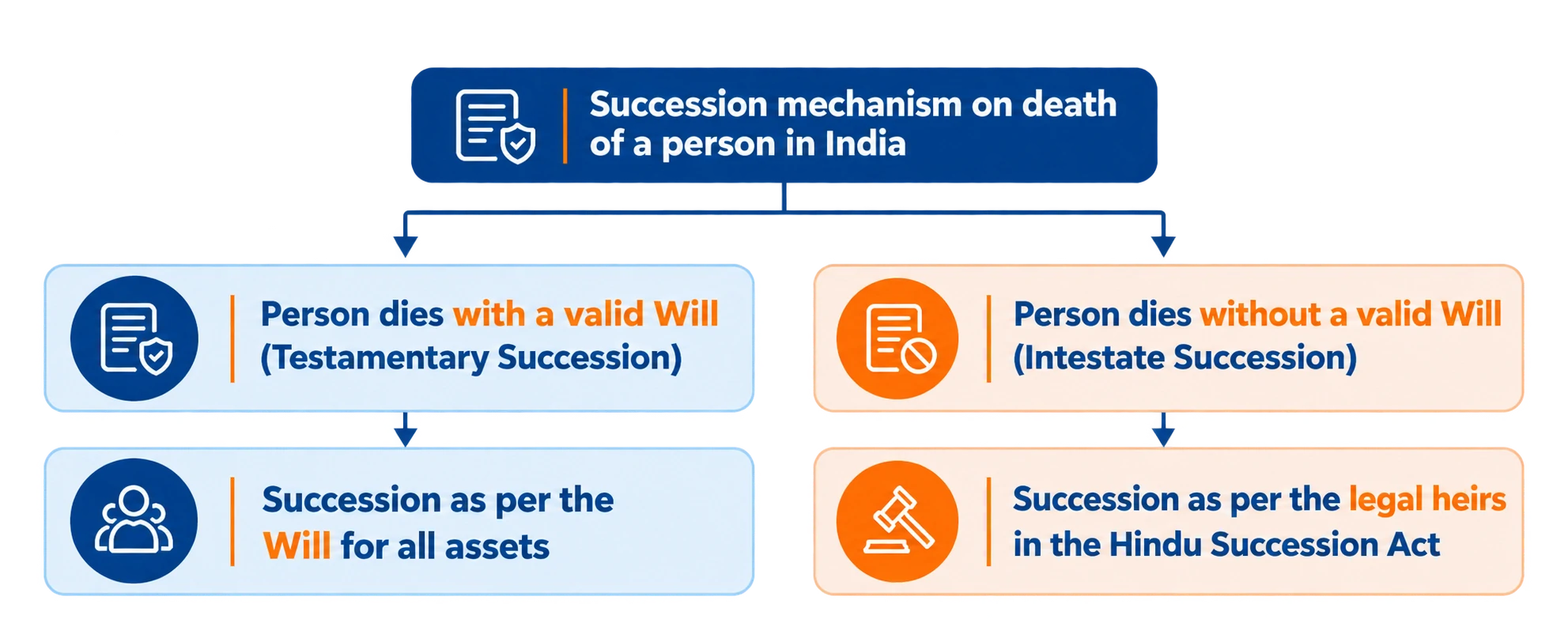
1
We begin by understanding your family circumstances, country of residence, long-term wishes, and estate-planning requirements.
Your family responsibilities and intended beneficiaries
Your assets in India and other countries
Your existing Will, if any
Your preferred distribution of eligible assets
Any special family or succession considerations
2
We help you organise the details needed for estate planning so that your assets and ownership interests can be identified clearly.
Indian and overseas property
Bank deposits, shares, mutual funds, and other investments
Insurance policies and existing nominations
Loans, liabilities, and jointly owned assets
HUF interests and existing trust arrangements, where applicable
3
We help you organise your intended distribution of eligible assets among your chosen beneficiaries.
Identifying beneficiaries and their respective shares
Planning for your spouse, children, parents, and other dependants
Considering an executor to carry out your Will
Deciding what should happen if a beneficiary dies before you
Including provisions for assets that may be acquired in the future
4
The Will should be reviewed by a qualified legal professional to reflect your wishes and meet legal requirements. NRIs should take extra care with overseas assets or an existing foreign Will
Asset Details: Verify asset ownership and details.
Beneficiaries: Confirm the intended beneficiaries.
Distribution Instructions: Ensure assets are distributed as intended.
Legal Compliance: Check applicable legal requirements.
Overseas Will: Address any conflicts with an existing Will abroad.
5
Once the draft is finalised, the Will must be signed and witnessed in accordance with the legal requirements that apply to it.
Applicable signing and witnessing requirements
Procedures for executing the Will while residing abroad
Whether notarisation, consular formalities, or other authentication may be relevant
Whether registration or other procedures are advisable
Secure storage of the original document and clear instructions for locating it
6
Your estate plan should be reviewed when your personal circumstances, assets, or legal position change.
Moving to another country or changing your residence circumstances
Marriage, separation, or changes in family responsibilities
The birth of a child or a change in dependants
Buying or selling significant property or investments
Changes in beneficiaries or your distribution preferences
Preparing a new Will in India or another country
Other service providers bill you separately for each service, making you pay more at extra costs.


Achieving financial stability begins with the right advice. Our experienced advisors help you identify suitable investment opportunities, manage risks, and create a clear strategy for long-term financial growth.

























Find quick answers to common questions about our services, processes, and financial solutions.
Will Planning is the process of deciding and documenting how your eligible assets should be distributed after your death.
Adults who want to clearly record their wishes for the distribution of their assets can consider making a Will, subject to applicable legal requirements.
No, registration of a Will is generally optional in India. However, registration alone does not guarantee its validity or prevent legal challenges.
Generally, an ordinary Will governed by Section 63 of the Indian Succession Act requires at least two witnesses. Different rules may apply in certain circumstances.
Yes, eligible investments such as shares, mutual funds, and bank deposits may be covered, subject to applicable laws, ownership rights, and relevant procedures.
No. A nomination and a Will serve different purposes. The legal effect of a nomination depends on the type of asset and the applicable law.
Yes, you can generally change or revoke your Will while you have the required legal capacity, subject to applicable laws and formalities.
A clearly written Will can help reduce confusion and misunderstandings, but it cannot guarantee that family disputes will not occur.
Yes, NRIs with assets in India or other countries may benefit from Will Planning that considers the laws applicable in each country.
Ashutosh Financial Services should clearly specify its authorised Will Planning services. Legal drafting and legal advice should be provided by qualified legal professionals.
Disclaimer: Clicking a login button will redirect you to an external portfolio platform.