

Health Insurance
The Covid-19 Pandemic has taught us all the importance of health insurance. People end up with no savings in case of a medical emergency if they do not have a Health Insurance Policy. The cost of medicines and medical treatments is increasing at an alarming rate and therefore it is imperative that one should have Health insurance. A health insurance policy extends coverage against medical expenses incurred owing to accidents, illness, or injury. During this policy period, if an insured meet with an accident or is diagnosed with a severe ailment, the expenses incurred for treatment purposes are borne by the insurance company.
Health insurance is essential for everyone to meet the rising cost of hospitalization. One of the important reasons to buy health insurance for your family and for yourself is that the cost of a sudden hospitalization is high, which you cannot afford or it disrupts your financial stability. By paying only a small premium for health insurance, the cost of hospitalization in the event of a medical crisis can be recovered from the insurance company. Health insurance can also be taken for all employees working in the company/firm/factory.
Essentials Of A Health / Mediclaim Policy:

TYPES OF HEALTH INSURANCE:
1) Individual Health Insurance:
Individual health insurance is an insurance plan that offers medical coverage to a person on an individual sum insured basis. It allows you to customize the coverage as per your own health needs and not of the entire family.
Most individual health insurance plans provide comprehensive coverage for emergency medical expenses resulting from hospitalization costs, day care procedures, road ambulance services, alternative treatment, organ donor expenses, etc. However, coverage of an individual health policy cannot be shared amongst your family members.
An Individual Health Insurance Plan is advisable for people who have their own health issues. This plan provides exclusive coverage to you and you do not share this coverage with anyone.
2) Floater Health Insurance:
A Family Floater is a type of health insurance policy in which the medical coverage of a policy extends to the entire family instead of an individual. A floater health insurance policy puts the whole family under an umbrella cover. The most important benefit of a floater family policy is that any member of the family can utilize as much cover amount as needed. The total cover of the family for the year is limited to the policy coverage or sum assured but there are no individual limits among family members when it comes to utilizing the insurance cover for medical treatments.
Another benefit of Floater Health Insurance is that the premiums of such policy are lesser than Individual Health Policies. This also ensures that you have to manage only 1 policy instead of 4-5 individual health insurance policies.
3) Super Top-Up Health Insurance:
Super Top-Up Health Insurance is a type of insurance policy wherein you can decide how much of the medical cost will be borne by you and the insurance company. In this insurance policy, you will have to list down two important amounts: 1) Sum Assured Amount & 2) Deductible Amount. The biggest benefit of this type of insurance plan is that the premium is much lower as compared to individual health insurance or a family floater health insurance.
A super top-up health plan covers the total hospital bills up to the limit specified in your super top-up plan above the deductible amount. Hence, once your deductible is paid, the super top-up policy becomes active for subsequent claims.
4) Long-Term Health Insurance:
Long Term Health Insurance Plans are health insurance plans that have a validity of 2-3 years. It provides all the benefits of the basic insurance policy but the only difference is that it locks your insurance coverage for 2-3 years at a time. This ensures that you do not have to renew your policy everywhere as well as that you are immune to all the premium revisions as your policy is locked for 2-3 years. Moreover, you also get additional discounts on premiums when you take a long-term health insurance plan.
5) Group Health Insurance:
Group Health Insurance also known as corporate health insurance is a type of insurance that provides medical coverage to a specific group of individuals such as employees of a company or members of an organization. It is usually purchased by companies and organizations to provide additional medical coverage to their employees as an added benefit. A Group Health Insurance policy helps in reducing the company’s or organization’s liabilities and risks coming from the employee’s end.
6) Critical Illness Insurance:
Critical Illness Insurance is a type of insurance that provides medical coverage against serious and long-term illnesses that require extensive treatment. Most health insurance companies provide critical illness rider cover on payment of an additional premium that helps you pay for the expensive medical treatment. In a critical illness policy, you will be provided with a lump sum amount on first-time detection or diagnosis of a covered critical illness.
A simple medical emergency has the potential to ruin your financial stability, now imagine what impact an illness like cancer or a heart attack can have on your financial plan. It is therefore advisable to also have a critical insurance policy. We are at a greater risk of developing critical illnesses at a later date due to the type of food, lifestyle, and sleeping patterns that we currently have.
7) Personal Accident Insurance:
Personal Accident Insurance is a type of insurance that provides complete financial protection to the insured individual from uncertainties like accidental death, Accidental body injuries, and total/partial/temporary/permanent disabilities arising from an accident. An accident is an uncertain event and can come knocking at the door at any time. Any accident can lead to minor or serious injuries. Such an uncertain event can create financial instability. Therefore it is better to have a personal accident insurance policy.
A personal accident insurance policy will provide you and your family cover in case of hospitalization or accidental death. According to the official government statistics more than 1 lakh people die in road accidents in India in a year.
Here are the essentials of a good personal accident insurance policy:

8) Pet Dog Insurance:
This insurance can be bought by any individual who owns a pet dog and would like to have protection against various expenses that will be incurred in order to treat the dog in event of an accident or illness. Pet dog insurance gives your dog the best medical care while protecting your bank account from unexpected, and expensive, veterinary bills.
Essentials Of A Good Pet Dog Insurance Policy:
Personal Accident Insurance:
Personal Accident Insurance is a type of insurance that provides complete financial protection to the insured individual from uncertainties like accidental death, Accidental body injuries, and total/partial/temporary/permanent disabilities arising from an accident. An accident is an uncertain event and can come knocking at the door at any time. Any accident can lead to minor or serious injuries. Such an uncertain event can create financial instability. Therefore it is better to have a personal accident insurance policy.
A personal accident insurance policy will provide you and your family cover in case of hospitalization or accidental death. According to the official government statistics more than 1 lakh people die in road accidents in India in a year.
Here are the essentials of a good personal accident insurance policy:
The following benefits / features are offered in Personal Accident Insurance
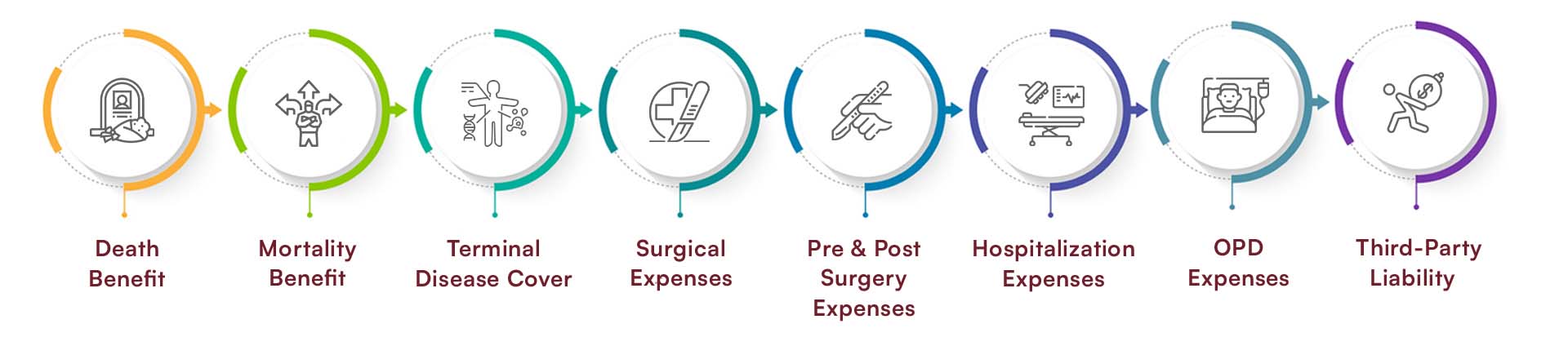
1. Death benefit :
In case of accidental injury of the insured person within 12 months or immediate death due to the accident, the sum insured will be paid by the insurance company to the nominee of the insured person.
- When the insured person dies due to an accident and transport of his body from the place of accident to the hospital, crematorium or place of burial, an additional amount of 1% of the airfare will be paid.
- In addition to all these expenses, 1% of the flight amount will be payable for the funeral expenses of the insured person.
2. Transportation of Mortal Remains Expenses :
Transportation of Mortal Remains Expenses refers to the costs associated with moving a deceased person’s body from the location of their demise to their residence, hospital, or cremation ground.
3. Funeral Expenses :
This type of insurance is designed specifically to cover funeral expenses when the insured person dies.
4. Permanent Total Disability Benefit :
Total Permanent Disability, cover offers financial security to you and your loved ones if you are incapable of earning due to an accident. It can help you meet the basic needs as well as assist you to maintain a standard lifestyle.
5. Permanent Partial Disability Benefit
Partial disabilities refer to loss of use of one organ or partial loss of us. However, to fall under this classification the disability has to be permanent.
6. Loss of Income/Temporary Disability Benefit :
It refers to injuries or illness that affects an individual completely but for a short or temporary period.
7. Accidental Hospitalization Expenses :
Hospitalization expenses incurred due to injury due to an accident will be paid by the insurance company.
8. Day Care Treatment Expenses :
Due to modern technology, it is not necessary for you to be hospitalized for 24 hours, but your operation should last for a minimum of 2 hours with anaesthesia.
9. Hospital Daily Cash Benefit :
It is a fixed daily allowance that is paid to the policyholder to meet miscellaneous expenses during the period of hospitalization.
10. Pre & Post Hospitalization Expenses :
Pre-hospitalization expenses are medical expenses incurred by an insured person before getting admitted in a hospital. Post-hospitalization expenses are medical expenses incurred once discharged from the hospital. These are covered by most health insurance companies.
11. Fracture Care Benefit :
Fracture Care is a personalised plan that covers your lifestyle-related health expenses. It offers benefits on doctor consultation, lab and radiology wallet, health and self-care benefits, and network discounts.
12. Coma Due to Accidental Bodily Injury Benefit :
If the insured person suffers an injury due to an accident, caused by an event/ peril covered and as a result of the Injury, solely and directly, the insured person suffers from Coma, we will pay the sum insured as specified.
13. Children’s Education Benefit :
After the insured’s death or permanent total disability claim is accepted by the insurance company, they will provide benefit to their schooling children up to the age of 25 years.
14. Emergency Road and Air Ambulance Benefit :
It provide Expenses for ambulance transportation in an aeroplane or helicopter and emergency are given to insured person
15. EMI Benefit :
After the claim of permanent partial disability is accepted by the insurance company, when you are unable to do your work due to that disability, a minimum of 1 month and a maximum of 1 month till you are able to do your work again or up to three months of EMI. (EMI) will be paid by the insurance company.
16. Travel Expenses :
Travel insurance financially covers you in the event of partial/total disability or bodily injury caused by an accident. If the policyholder dies, the nominee gets compensation. It helps financially stabilise the policyholder and their family if they become disabled due to an accident.
17. Loan Protector :
In case of death or permanent total disability claim within 12 months of the accident injury of the insured person, the loan amount due from the date of your accident will be paid by the insurance company but this is optional. Only the insurance amount taken under the cover can be claimed.
Types of Personal Accident:
1. Individual accident insurance :
This is a personal accident insurance policy which covers the main policyholder against any financial losses arising due to an accident. Here, the individual policyholder receives the coverage for accidental death or any kind of permanent or temporary disability arising due to an accident.
2. Group accident insurance :
In this policy , a group of individuals such as employee, receive the coverage for accident insurance.In the case of employees, generally their employee provide them with accident insurance which comes at much lower premium costs. However, the benefits of group insurance would be very limited as compared to individual accident policy.
Travel Insurance Policy:
A travel insurance policy covers various kinds of financial losses that one might encounter during their travel. The policy term is usually the entire duration of the trip. While this protection is quite useful while traveling abroad, one can also get travel insurance to cover their trips within the country. you could get coverage for emergency medical expenses while traveling, trip cancellation and delay, loss of baggage, delay of checked-in baggage, loss of passport, accidental death or disability, and so on.
Here are the essentials of a good personal accident insurance policy:

The following benefits/features are offered in Travel Insurance Policy:
1. Accident & sickness medical expense :
Accident & Sickness Medical Expense in travel insurance refers to coverage for unexpected injuries or illnesses that require immediate medical attention during your trip. If you experience an accidental injury or a sudden illness this benefit can provide reimbursement for eligible medical expenses covered by your policy.
2. Accidental death & dismemberment benefit :
The Accidental Death and Dismemberment (AD&D) benefit in travel insurance provides financial compensation to you, your beneficiary if there is an unexpected accident-causing sustained injury to you, such as dismemberment (loss of limbs or irrecoverable loss of vision in at least one eye) or results in your death while you are traveling.
3. Emergency medical evacuation Benefit :
Emergency Medical Evacuation Insurance in travel insurance provides coverage for transporting you from a remote or inadequate medical facility to a better-equipped center, typically by airlift or ambulance. If you sustain a serious injury or illness during your trip and require urgent care, this benefit ensures you receive timely medical transportation.
4. Baggage delay benefit :
Baggage delay insurance is a travel insurance benefit that helps you financially if your checked luggage arrives late at your destination. It reimburses you for essential items you need to purchase while waiting for your bags. For instance, if your baggage is delayed, you can claim expenses for necessities like toiletries, clothing, and other essentials.
5. Checked baggage loss benefit :
Checked baggage loss insurance covers baggage that is lost, damaged, or stolen during your trip. However, not everything in your bags might fall under the insurance coverage.
6. Loss of passport benefit :
If you lose your passport while you are on a trip, the company reimburse the necessary expenses you had to incur to obtain its duplicate copy or new passport.
7. Personal liability benefit :
The Company shall indemnify the Insured against legal liability for bodily Injury or property damage to third parties arising on account of an Accident occurring whilst on a trip any time.
8. Flight delay :
It provides coverage when your trip experiences delays due to specific reasons. Common reasons for delays include adverse weather conditions, aircraft maintenance issues, lost or stolen passports, and natural disasters.
9. Sickness dental relief :
It compensates the Insured for the reasonable Medical Expenses incurred by the Insured in connection with treatment for any Injury or Illness to his/ her natural tooth or teeth during the trip.
10. Repatriation of remains :
In the unfortunate event of the death of the Insured whilst abroad during the Period of Insurance, the Company shall, reimburse the nominee, the costs incurred for transporting the remains of the deceased Insured back to the Country of Residence of the Insured or, up to an equivalent amount, for a local burial or cremation in the country where the death has occurred.
11. Hijack :
It is a coverage provided in international travel insurance plans. It assists insured members during distress caused by a public vessel hijacking. If you’re unfortunate enough to experience a hijack.
12. Home burglary :
Home burglary coverage in travel insurance provides protection for your home in case of a burglary while you are abroad for a trip.
13. Trip cancellation :
The Company shall indemnify the Insured for the financial loss incurred by the Insured arising out of cancellation of the trip.
Types Of Travel Insurance :
1. Domestic travel insurance :
The Domestic Travel Insurance policy covers you in case of unforeseen expenses during your travel within India. all your trips including rail, road and air travel will be covered against accident and accidental hospitalization. Your domestic policy may cover emergency assistance, cancellation fees, lost personal effects, personal liability, travel dealys and more.
2. Group travel insurance :
Group travel insurance provides financial protection for trips involving 10 or more people. it functions similar to other travel insurance policies, covering aspect such as medical emergencies, luggage loss and trip cancellations. The significant advantage of group travel insurance is that it costs less than purchasing individual policies for each member.
3. Global travel insurance :
A global travel insurance policy is a plan you purchase to protect yourself from certain financial risks and losses while traveling internationally. It covers unexpected events that could otherwise leave you out of pocket. These losses can range from minor inconveniences like a delayed suitcase to significant issues like last minute trip cancellation or medical emergencies abroad.
The health insurance is a type of insurance that covers your medical expenses. A health insurance policy is a contract between an insurer and an individual/group in which the insurer agrees to provide specified health insurance cover at a particular “premium”.
The commonest form of health insurance policies in India covers the expenses incurred on Hospitalization, though a variety of products are now available which offer a range of health covers, depending on the need and choice of the insured. The health insurer usually provides either direct payment to the hospital (cashless facility) or reimburses the expenses associated with illnesses and injuries or disburses a fixed benefit on occurrence of an illness. The type and amount of health care costs that will be covered by the health plan are specified in advance.
All of us should buy health insurance and for all members of our family, according to our needs. Buying health insurance protects us from the sudden, unexpected costs of hospitalization (or other covered health events, like critical illnesses) which would otherwise make a major dent into household savings or even lead to indebtedness. Each of us is exposed to various health hazards and a medical emergency can strike anyone of us without any prior warning. Healthcare is increasingly expensive, with technological advances, new procedures, and more effective medicines that have also driven up the costs of healthcare. While these high treatment expenses may be beyond the reach of many, taking the security of health insurance is much more affordable.
Insurance companies have tie-up arrangements with several hospitals all over the country as part of their network. Under a health insurance policy offering cashless facility, a policyholder can take treatment in any of the network hospitals without having to pay the hospital bills as the payment is made to the hospital directly by the Third Party Administrator, on behalf of the insurance company. However, expenses beyond the limits or sub-limits allowed by the insurance policy or expenses not covered under the policy have to be settled by you directly with the hospital. Cashless facility, however, is not available if you take treatment in a hospital that is not in the network.
Health insurance comes with attractive tax benefits as an added incentive. There is an exclusive section of the Income Tax Act which provides tax benefits for health insurance, which is Section 80D.
Age is a major factor that determines the premium, the older you are the premium cost will be higher because you are more prone to illnesses. Previous medical history is another major factor that determines the premium. If no prior medical history exists, the premium will automatically be lower. Claim free years can also be a factor in determining the cost of the premium as it might benefit you with a certain percentage of the discount. This will automatically help you reduce your premium.
You must read the prospectus/policy and understand what is not covered under it.
When you get a new policy, generally, there will be a 30 days waiting period starting from the policy inception date, during which period any hospitalization charges will not be payable by the insurance companies. However, this is not applicable to any emergency hospitalization occurring due to an accident. This waiting period will not be applicable for subsequent policies under renewal.
It is a medical condition/disease that existed before you obtained health insurance policy, and it is significant because the insurance companies do not cover such pre-existing conditions, within 12/36/48 months as per different product before the 1st policy. It means pre-existing conditions can be considered for payment after completion of a waiting period of continuous insurance cover.
Yes. The Insurance Regulatory and Development Authority (IRDA) has issued a circular making it effective from 1st October 2011, which directs the insurance companies to allow portability from one insurance company to another and from one plan to another, without making the insured lose the renewal credits for pre-existing conditions, enjoyed in the previous policy.
Any number of claims is allowed during the policy period unless there is a specific cap prescribed in any policy. However, the sum insured is the maximum limit under the policy.
Some health insurance policies pay for specified expenses towards general health check up once in a few years.
Family Floater is one single policy that takes care of the hospitalization expenses of your entire family. The policy has one single sum insured, which can be utilized by any/all insured persons in any proportion or amount subject to the maximum overall limit of the policy sum insured.
If you are ever diagnosed with a critical illness, it can affect you physically, emotionally, and financially. the optional benefit of covering Critical Illnesses such as cancer, heart attack, and kidney failure for a maximum of 30 years without any change in premium. But here’s the best part – It gives full claim payout on the first diagnosis of any of the covered 34 Critical Illnesses. No Hospital Bills are required. This amount can also safeguard your family against the loss of income arising out of the illness.
One usually travels abroad for various reasons- a pleasure trip, a business trip, a study trip etc. You do not want anything to ruin your hard earned holiday, foreign study or your crucial business meeting. But there is a possibility of some unexpected occurrence no matter how perfect the planning is. Unfortunate events such as baggage loss, passport loss, a medical emergency or an accident can affect you. Having Overseas Travel Insurance protects you from all such perils.
Any person going abroad can take overseas travel insurance – a tourist, a businessman or a corporate executive, student, a person visiting his family members.
It covers medical emergencies, trip cancellations, and lost baggage, passport lost, flight delay, emergency medical evacuation, accident and sickness medical expense, accidental death & dismemberment benefit, checked baggage loss, personal liability benefit, sickness dental relief, repatriation of remains, hijack, home burglary.
No you don’t need a medical check-up before buying travel insurance.
It is recommended to buy Travel insurance soon after you make your first trip payment.