For millions of Indians living abroad, financial decision-making back home often relies on assumptions passed down through family conversations, forum posts, or advice that may have been accurate years ago but no longer holds true. Ashutosh Financial Services conducts financial awareness sessions precisely to close this gap between belief and fact, working on the premise that sound financial choices are only possible when they rest on current, accurate information rather than inherited assumptions.
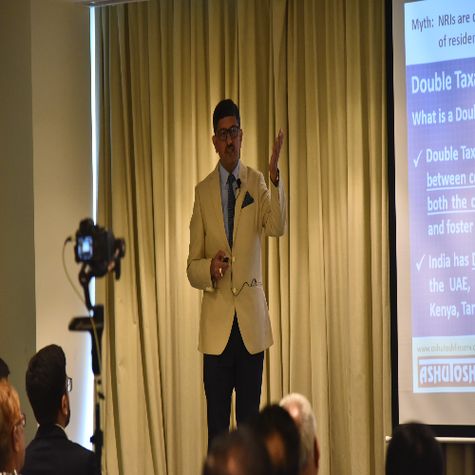
This philosophy shaped the “NRI Taxation & Regulations and NRI Investment Opportunities – Myths & Truths” conclave, held on 25th December 2022 across Rajkot, Ahmedabad, and Mumbai for an audience of Non-Resident Indians. The session was led by Daxesh Kothari and CA CFP Rajit Kothari, who structured the discussion around common misconceptions NRIs carry about their financial obligations and opportunities in India, correcting each one with the relevant law or regulation.
The regulatory portion of the session began by dismantling the idea that a single law governs NRI finances. In reality, the Income Tax Act determines taxability based on days of stay in India, the Foreign Exchange Management Act (FEMA) governs banking and investment activity, and the Citizenship Act and OCI provisions determine legal status and rights. This distinction matters because each law triggers different obligations. For instance, NRIs are not permitted to hold resident savings accounts under FEMA and must convert them to NRO accounts, while returning NRIs need to formally update their status with banks, insurers, and mutual funds and convert their NRO, NRE, and FCNR holdings into appropriate resident accounts.
Several misconceptions around repatriation and cross-border compliance were also addressed. Funds can be moved out of India up to USD 1 million per person per year from NRO accounts, with special RBI permission required beyond that. On the taxation side, the session explained the Double Taxation Avoidance Agreement (DTAA), which India holds with over 94 countries, and how residence-based and source-based taxation principles interact to prevent the same income from being taxed twice. A related point of confusion, particularly relevant for the US-based audience, concerned Green Card holders: holding a Green Card makes a person a US tax resident regardless of location, and if they simultaneously qualify as an Indian tax resident, a tie-breaker test involving permanent home and center of vital interest decides which country’s rules take precedence.
The session also worked through practical compliance mechanics, including how Tax Deducted at Source (TDS) applies differently to NRIs under Section 195, how lower or nil TDS certificates can be obtained, and how NRIs can legitimately reduce their tax liability through deductions under Sections 80C, 80D, 80G, 80TTA, and 24, along with capital gains exemptions under Sections 54, 54EC, and 54F. On succession, the speakers clarified that inheritance of assets in India follows Indian succession law rather than the NRI’s country of residence, that a nominee is only a custodian and not the legal owner of an asset, and that a valid Will can be executed abroad if properly witnessed and notarised.
The investment section moved from compliance to opportunity, using comparative economic data to question the assumption that NRIs invest in India purely out of sentiment. The presentation cited India’s 6.8% GDP growth rate for 2022, among the highest of major economies, alongside resilient stock market performance and currency movement relative to global peers. Beyond traditional NRE and NRO deposits, the session introduced alternatives such as Target Maturity Funds, FCNR deposits, corporate fixed deposits, and guaranteed-return insurance plans, each carrying different liquidity and tax characteristics. It also covered routes beyond listed equity and mutual funds, including Portfolio Management Services, unlisted shares, and Alternative Investment Funds, as well as REITs as a way to gain real estate exposure without direct property ownership. A recurring theme was that most banking, investment, and even real estate transactions can now be conducted digitally, without requiring the NRI’s physical presence in India.
The conclave closed by reinforcing that sound NRI financial planning rests on asset allocation, risk mitigation, capital protection, and goals that evolve with life stages, rather than on outdated assumptions. Sessions like this reflect a broader effort to ensure that the NRI community makes financial decisions grounded in current law and verified data, an effort Ashutosh Financial Services intends to continue through similar educational initiatives in the future.