

Assets & Liabilities Insurance
General Insurance or Assets & Liabilities Insurance is the insurance for all non-living things. It is often known as non-life insurance. These insurance policies are taken on various assets and liabilities of an individual. These assets include our cars, houses, scooters, factory shed, etc. Leaving out general insurance causes the same level of financial distress as it would have caused if one did not have a life or health insurance policy.
Assets & Liabilities insurance is the most neglected type of insurance as we believe we can always buy a new one or nothing bad will happen to our assets. However, these assets are the ones that are the most prone to accidents or other losses when compared to the claims received for life or health insurance policies.
Therefore it is imperative that everyone covers their assets and liabilities through general insurance to have a peaceful & stable life. General Insurance is a very important part of prudent financial planning.
General Information:
1) Fire Insurance:
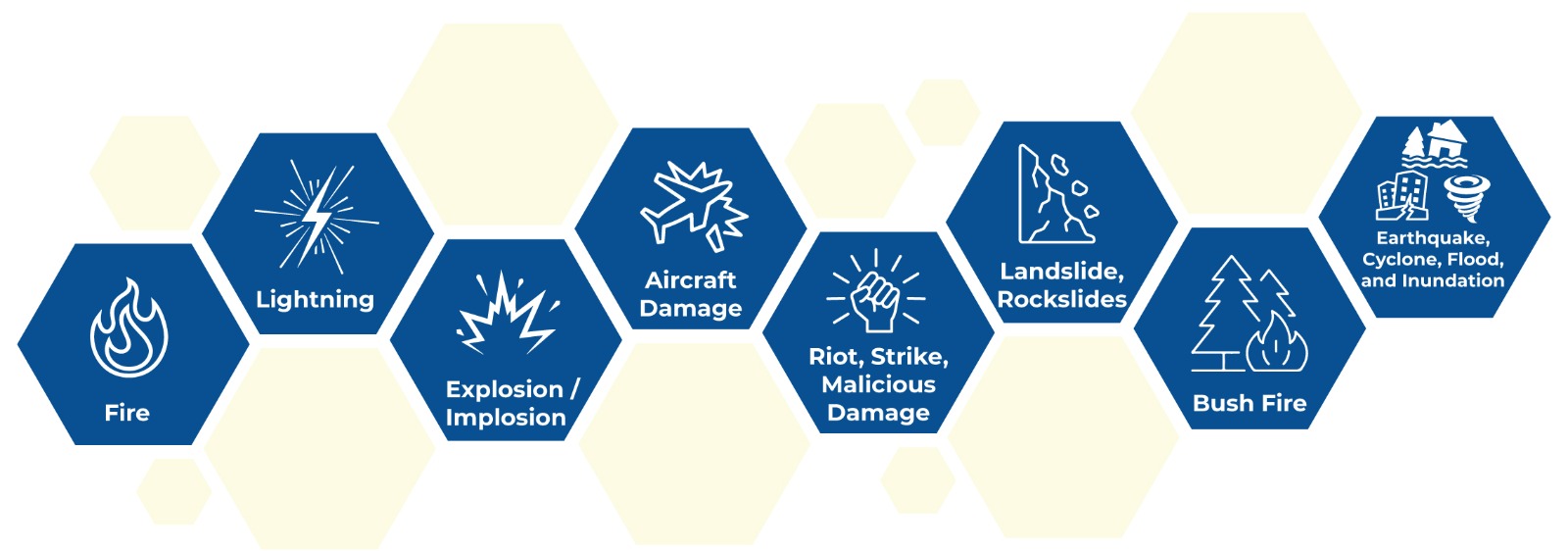
Fire Insurance is a type of insurance wherein an insurance company provides coverage against any loss or damage caused due to fire to an individual in exchange for a premium. Generally, this insurance is taken for properties like home, factory shed, godown, etc. This insurance protects you from sudden losses caused by fire from activities like lightning, earthquakes, and flood. This insurance comes in very handy when you choose to repair or rebuild the assets destroyed by fire.
Fire Insurance Cover Can Be Taken For The Following Assets:

Fire Insurance Provides Coverage Against The Following Events:
2) Motor Insurance:
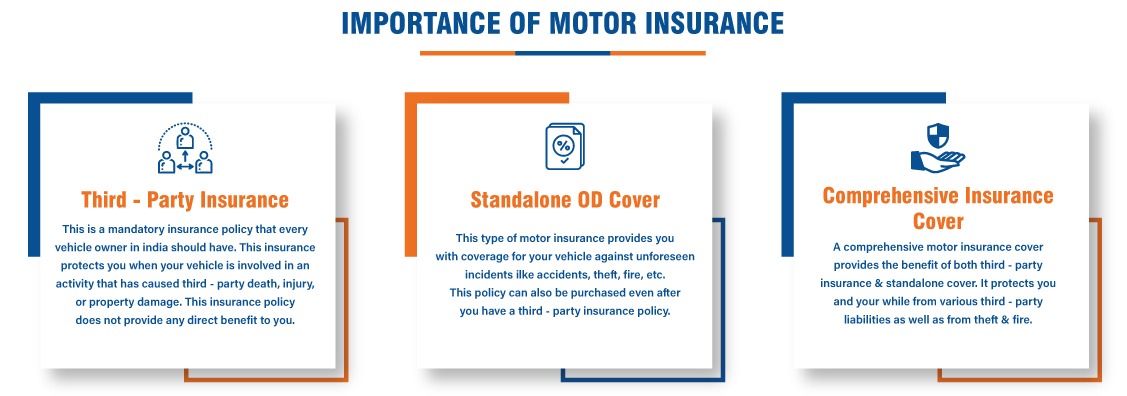
Motor Insurance is an insurance designed to offer coverage to Two-Wheelers, Four-Wheelers, Commercial Trucks & Other Road Vehicles from natural, man-made, and third-party liabilities. Third-Party Motor Insurance is a mandatory insurance that every vehicle owner in India must have.
3) Property Insurance:
Property Insurance or Home Insurance is a type of insurance that provides you coverage from theft, natural calamity, fire, accident, etc for your home and its contents. It is important to note that property insurance provides coverage for both your house’s structure and its contents too. This type of insurance comes in very handy when you need to rebuild or repair your house after an unforeseen event. Home insurance is a must-have type of insurance to ensure complete peace of mind.
4) Workmen Compensation Insurance:
Workmen compensation insurance is a type of insurance that provides wage replacement and medical benefits to employees injured in the course of employment in exchange for mandatory relinquishment of the employee’s right to sue his or her employer for the tort of negligence. A workmen’s compensation policy allows the employer to financially compensate the employees and their dependents. Workmen’s Compensation policy provides coverage for bodily injuries, disability, and death of unskilled, semi-skilled, and skilled employees caused by accidents during their employment.
5) Marine Insurance:
Marine Insurance is a type of insurance that provides coverage for the loss or damage caused to the transit vehicle and thereby the goods in it regardless of it being transported by ship, air, train, or truck. Marine insurance protects against losses or damage caused to any material, machine, or goods when transported by air, ship, or road within or outside the country.
6) Cyber Security Insurance:
Cybersecurity Insurance also known as cyber liability insurance is a type of insurance that reduces the financial risks of an organization doing online business. Cyber insurance is a new and emerging insurance plan that was developed especially to safeguard and provide coverage to various companies who are evolving and doing most of their business online.
As the world goes digital, more and more companies are adopting new and evolving technologies and are going digital. A lot of companies today rely on internet-based technology to reach out to their prospective clients and pursue their digital marketing goals and do business.
These businesses are therefore at the risk of various online frauds, data breaches, hacks, and a lot more. Hence cyber security insurance is necessary for all companies who are engaged in online businesses. Cyber Security insurance provides coverage to the company from the financial and reputational losses caused by cyber-attacks, data breaches, or hacks.
Below are the essentials of a good cyber security insurance policy:

7) Shopkeeper’s Insurance:
A shopkeeper’s insurance or shop insurance policy is a type of insurance that provides coverage for a shop’s contents and property. A shop insurance policy provides financial coverage to the shop owner in cases of theft, manmade disaster, natural calamity, etc. A shopkeeper insurance policy shields a small/medium-sized shopkeeper from any losses that he may face. This insurance protects the business and property interests of the shopkeeper.
Small or medium-scale shopkeepers have a very small profit margin and would not be able to bear any losses due to any unforeseen events, therefore it is imperative that all small and medium-sized shopkeepers have a shopkeeper’s insurance policy.
A shopkeeper’s insurance covers the loss or damage due to the following:

8) Burglary Insurance:
Burglary Insurance offers an additional layer of security to your property. It offers coverage for damages or misfortunes caused to your property from theft, violent entry, attempted theft, armed robbery, and burglary. Burglary insurance can be taken on your house, office, factory, or godown. Burglary insurance protects your property and covers any damages caused due to burglary or housebreaking like unexpected events.
9) Indemnity Insurance (Liability Insurance):
The term indemnity insurance refers to an insurance policy that compensates an insured party for certain unexpected damages or losses up to a certain limit usually the amount of the loss itself. These policies are commonly designed to protect professionals and business owners when they are found to be at fault for a specific event such as misjudgment or malpractice. They generally take the form of a letter of indemnity.
Certain professionals must carry indemnity insurance. These professionals include those involved in financial and legal services, such as financial advisors, insurance agents, accountants, mortgage brokers, and attorneys. Indemnity insurance is a supplemental form of liability insurance specific to certain professionals or service providers.
Indemnity insurance protects against claims arising from possible negligence or failure to perform that result in a client’s financial loss or legal entanglement. A client who suffers a loss can file a civil claim. In response, the professional’s indemnity insurance will pay litigation costs as well as any damages awarded by the court.
10) Machinery Breakdown Policy:
Machinery breakdown insurance provides a security cover to the machines used by factories and industries. This insurance covers accidental breakdown and physical damage of the machinery, the cost of repairs or replacement of the damaged machine parts.
• Importance of machine break down policy
1. Coverage for Sudden Breakdowns:
Machinery breakdown insurance ensures that the insurer covers unforeseen damage caused to insured machinery while it’s at work or rest. It covers the cost of repairing or replacing damaged parts.
2. Business Continuity:
When machinery breaks down unexpectedly, it disrupts the entire manufacturing ecosystem. Having insurance helps mitigate losses due to downtime and repair expenses.
3. Risk Mitigation:
Machinery breakdowns can lead to significant financial losses. Having insurance helps mitigate these risks by covering repair or replacement costs.
4. Electrical and Mechanical Failures:
The policy covers breakdowns due to electrical or mechanical failures, accidental damage, and operator errors.
• Details of machine breakdown policy
This insurance basically helps organisations using machines. It covers the loss that the business may face due to the sudden breakdown of the machinery. The organisation gets the money from the insurance company for the repair or replacement of the machinery as per the need and requirement. This insurance helps organisations grow by overcoming such losses.
• Who need Machine break down policy
- Businesses that rely on machinery, equipment, and other technology for their operations.
- Companies that operate in industries with high-risk machineries, such as manufacturing, agriculture, construction, and mining.
- Companies with large, expensive machinery or equipment that could be costly to repair or replace.
- Businesses that can incur significant financial losses if their machinery suddenly breaks down.
- Companies that require specialised machinery, such as those used in medical or industrial settings.
- Businesses that operate in areas with frequent electrical outages or other power disruptions.
• Common risk scenario in machine break down insurance
- Short circuits and electrical problems.
- Mechanical faults such as if an unexpected machinery breakdown.
- Damage from pressure systems.
- Damage to the machinery, plant, and equipment caused by sudden and unforeseen physical event such as lightning, earthquake, fire, flood, or explosion.
Driving a motor vehicle without insurance in a public place is a punishable offence in terms of the Motor Vehicles Act, 1988.
Damage to one’s own vehicle by taking out vehicle insurance, in addition to damage to the third party vehicle or property due to an accident, is also compensated by the insurance company for the death or injury of a person due to an accident.
The following two main types of insurance are offered in motor insurance.
Own Damage Insurance :
- This type of insurance is called full insurance in which an IDV (Insured Declared Value), the sum insured of the vehicle is paid as the cost by the insurance company up to that IDV. The insurance company will also pay for the damage caused to its own vehicle and the damage caused to the other party from the accident.
Third Party Liability Only Insurance :
- In this type of insurance, the cost of damage to one’s own vehicle is not cover by the insurance company, but the cost of the damage caused to the other party by the accident will be covered by the insurance company.
The following are the add on of Motor Insurance:
1. Engine Secure:
- It Pays for repair & replacement or damage to Internal parts of engine; Gear Box, Transmission & Differential assemble and related consumable excluding fuel. In this is add-on cover the cost of replacing or repairing the internal parts of the engine will be paid by the insurance company when it stops suddenly due to water infiltration in the engine of the vehicle.
Claims will not be admissible under this add on cover under the following circumstances:
- When the engine is under manufacturing warranty.
- When you report the loss to the insurance company 2 (two) days after the loss.
- When your vehicle is rusted and damaged.
- When loss occurs due to leakage of lubricant or any type of oil in the vehicle.
- When the engine of your vehicle stops due to water ingress, even though you repeatedly try to start the vehicle by self-killing.
2. Consumables Expenses:
- Covers cost of consumables required to be replaced/replenished arising from an accident to the insured vehicle. Consumable for the purpose of this cover shall include engine oil, gear box oil, lubricants, nut & bolt, screw, distilled water, grease, oil filter, bearing, washers, clip, break oil, air conditioner gas and items of similar nature excluding fuel.
Not Cover:
- If there is no valid and admissible claim under Own Damage of the policy
- If vehicle is not repaired at Authorized garage
3. Tyre Secure:
- Cover expenses for repair and/or replacement, as may be necessitated arising out of accidental loss or damage to tyres and tubes.
- Maximum of 4 (four) replacements will be allowed during the Period of Insurance (4 different places will be taken for the purpose of arriving at means tread depth which will be the basis of indemnity under the coverage).
- In any situation company’s liability would not exceed the following, basis the unused tread depth of respective tyre (not applicable if full cover is opted).
- Unused tread depth of <3 mm – Considered as normal wear and tear and is not covered.
- Unused tread depth of >- 3 to < 5 mm – 50% of cost of new tyre and/or tube.
- Unused tread depth of >=5 to < 7 mm – 75% of cost of new tyre and/or tube.
- Unused tread depth of > = 7 mm – 100% of cost of new tyre and/or tube.
Not Covered:
- If vehicle is not repaired at Authorized garage.
- Any loss or damage within first 15 days of inception of the policy.
- Loss or damage resulting into total loss of the vehicle.
Loss or damage resulting from hard driving due to race, rally or illegal activities.
4. Road Side Assistance:
- Provides On the Spot Assistance Services in case of an Accident or Breakdown of vehicle
Limitations:
- The services would not be provided under: Acts of God, Earthquake, Fire, War, Invasion, Rebellion Revolt, Riot, civil commotion, civil war, Acts of Terrorism, Nuclear Fission, Strike, Act(s) of Omission/Commission by any concerned, Government(s) or Government Agencies, Judicial or Quasi-judicial authorities.
- Vehicles should not be used for the purpose of racing, rallying, motor-sports, or in any instance where the Vehicle is not being used /driven in accordance with applicable laws and regulations
- You can avail of these services for maximum of 4 times during the course of the policy period
- Offered up to 10 Yrs
5. Depreciation Reimbursement:
- pay you the amount of depreciation deducted on the value of parts replaced under own damage claim, lodged under section 1 (own damage) of the policy. We will pay for the first 2 claims reported to Us during the Period of insurance.
Conditions:
- A claim where replacement of any part is not involved and no depreciation is deducted under own damage claim, will not be considered as claim under this cover.
- Vehicle is repaired at any of our Authorized Garage/Authorized workshop/Authorized service station.
6. Return to Invoice:
- Pay the financial shortfall between the amount you receive under owner damage of the policy and the purchase price of the Vehicle as confirmed in the invoice of sale OR current replacement price of new vehicle in case exactly same make/model is available, whichever is less, in the event of your vehicle being a total loss following an accident or stolen during the period of insurance and not recovered. Also reimburse the first time registration charges and road tax which you had incurred on the insured Vehicle.
- Conditions: To the 1st registered vehicle owner.
7. Loss of Personal Belongings :
- Personal belongings caused by perils mentioned under owner damage of the policy while they are in the vehicle at the time of loss or damage to the vehicle.
- Money, securities, cheques, drafts, credit or debit cards, jewellery, lens, glasses, travel tickets, watches, valuables, manuscripts, paintings, goods in trade or samples and items of similar nature.
- The insured will bear first Rs. 250 of each and every claim.
8. Emergency Transport & hotel expenses:
- Pay towards the cost of overnight stay and taxi charges for returning back to Your place of residence or the nearest city you are traveling to if your motor vehicle has met with an accident
- SI – 10,000 / 50,000
- Per occurrence claim limit of 50% of Sum Insured
9. Key Replacement:
- Reimburse you for the cost of replacing your locks and keys if Your vehicle is broken into. The covered costs include the labor cost for replacing the lock
- SI – 25,000/ 65,000
- Per occurrence claim limit of 50% of Sum Insured
Not Covered: The cost to replace keys to vehicles that You do not own for personal use
Condition: For break-in protection claims, you must provide an official police report that confirms the incident happened within the period of insurance
10. Repair of Glass, Fiber, Plastic & Rubber Parts:
- A claim for only Glass/plastic/rubber/fiber part where You opt for repairs rather than replacement, at our authorized workshops/authorized dealers/authorized service stations will not affect your no claim bonus.
11. Personal Accident to Unnamed Passengers:
- It is hereby understood and agreed that the insurer undertakes to pay compensation on the scale provided below for bodily injuries hereinafter defined sustained by any passenger.
12. Personal Accident cover for owner - driver:
When the owner of the vehicle is driving the vehicle himself or he is traveling as a co-driver, if the owner of the vehicle meets with an accident and the following conditions arise within 6 months of the accident, then a claim for the higher amount will be available.
Note : In all the above four cases of accident, if the following situation arises due to injury due to the accident, then the claim money is given by the insurance company as per the following percentage of the fixed sum of money.
- Death : 100%
- Loss of two limbs or loss of both eyes or loss of one limb and one eye: 100%
- Loss of a limb or an eye: 50%
- Permanent total disability except in all three situations given above : 100%
13. Personal accident to unnamed passengers other than the insured and the paid driver and cleaner:
When an accident results in the death/injury of passengers and the following situations occur within 3 months of the accident, a claim for the corresponding higher amount will be available.
Note : In all the above four cases of accident, if the following situation arises due to injury due to the accident, then the claim money is given by the insurance company as per the following percentage of the fixed sum of money.
- Death : 100 %
- Loss of two limbs or loss of both eyes or loss of one limb and one eye: 100%.
- Loss of a limb or an eye: 50%.
- Permanent total disability except in all three situations given above : 100%.
14.Personal accident cover to the insured or any named person other than paid driver or cleaner:
A claim for a greater sum of money in case of death/injury of the persons named at the time of taking the policy which is connected to the insured vehicle and that person is by/with the vehicle and the following circumstances arise within 6 months of the occurrence of the accident will be available.
Note : In all the above four cases of accident, if the following situation arises due to injury due to the accident, then the claim money is given by the insurance company as per the following percentage of the fixed sum of money.
- Death : 100%
- Loss of two limbs or loss of both eyes or loss of one limb and one eye: 100%.
- Loss of a limb or an eye: 50%.
- Permanent total disability except in all three situations given above : 100%.
15. Personal accident cover to paid drivers, cleaners and conductors:
When an accident results in death/injury of a pad driver, cleaner or conductor and the following circumstances occur within 6 months of the accident, a claim for the following large amounts will be available.
Note : In all the above four cases of accident, if the following situation arises due to injury due to the accident, then the claim money is given by the insurance company as per the following percentage of the fixed sum of money.
- Death : 100%.
- Loss of two limbs or loss of both eyes or loss of one limb and one eye: 100%.
- Loss of a limb or an eye: 50%.
- Permanent total disability except in all three situations given above : 100%.
16. Legal liability to paid driver and/or conductor and/or cleaner employed in connection with the operation of insured vehicle:
Workmen’s Compensation Act, 1923, The Fatal Accidents Act, 1855 or at Common Law and subsequent amendments of these Acts According to if injured, compensation will be given.
17. Legal liability to employees of the insured other than paid driver and/or conductor and/or cleaner who may be travelling or driving in the employer’s car:
Liability under the Fatal Accidents Act, 1855 for compensation (including legal costs of any claimant) for death of or bodily injury to any employee (other than paid drivers) Taking this cover will provide compensation.
Note: You can take this cover for a total of 5 (five) employees (including the driver). But the names of the 5 (five) employees for whom you take this cover have to be given at the time of taking the policy.
Yes. Under the Motor Vehicles Act, all motor vehicle owners must have third party insurance cover.
The law in the country makes it compulsory for you to insure your motor vehicle. The compulsory nature of the law protects you against third party liability. While insuring against third party liability is important, it also makes good sense to buy a comprehensive cover to give you all round protection.
The basic insurance covers offered are as under:
- Liability Only Policy: covering the liabilities towards third parties only, as per Motor Vehicles Act. This insurance is mandatory for a vehicle plying in public roads, as per Motor Vehicles Act.
- Package Policy: In addition to the above, the loss or damage to the vehicle insured, by specified perils, is also covered subject to the value declared and other terms and conditions in the policy.
No claim bonus is a special discount given for every claim-free year. As per the schedule of tariff, NCB can be earned in the Own Damage section of Policies covering all classes of vehicles but not on Motor Trade Policies (Road Transit Risks / Road Risks / Internal Risks) and policies that cover only Fire and / or Theft Risks.
Yes, in case you are changing insurance company have accrued some NCB from previous insurer, then you get the benefits for your NCB with new company too.
The discount rate remains the same; provided you show evidence that you are entitled to No Claim Bonus from your previous motor insurance company. Evidence can be in form of a renewal notice or a letter confirming the NCB entitlement from the previous insurer.
A cover note is a interim cover of insurance issued by the Insurer before the issuance of a policy, after the Insured has given a duly filled in proposal form and has paid the premium in full. A cover note is valid for a period of 60 days from the date of issue of the cover note and the Insurer shall issue the Certificate of Insurance before the cover note expires.
Incidents such as “Third Party Property Damage”, “Bodily Injury To Self or Third Party” or “Theft” should be reported to the nearest police station, under whose jurisdiction the incident has occurred.
A comprehensive car policy covers transportation risk by rail, road and inland waterways.
Insurance can be done at any of offices of General Insurance companies generally doing Motor Insurance business.
Premium depends upon various factors viz. type, make, model, cc, usage, place of registration, past claims history etc. of the vehicle. Therefore approach insurance company with vehicle details for exact premium.
Please approach the Insurance companies concerned directly.
Yes, it is possible. A fresh proposal form needs to be filled in. The office may also insist for physical inspection of vehicle and other formalities, depending upon the situation. Please contact the nearest office for assistance.
Depends on company to company.
It is strongly recommended to renew your insurance before expiry of the existing insurance. This keeps your vehicle insured against the risks without any break and takes care of any loss within the ambit of the policy you have. This also retains the No Claim Bonus–the hard earned discount in premium for claim free year/s. Moreover, you are also not worried about the breach of law.
If, the policy has already expired, a fresh insurance can be obtained. Since a break in insurance has occurred, the vehicle will be physically inspected by a company official or an authorized representative/agency, at your cost. The entitlement of No Claim Bonus will be as per rules.
Yes, the insurance can be transferred to the buyer of the vehicle, provided the seller gives in writing to the insurance company. A fresh proposal form needs to be filled in. There is a nominal fee charged for transfer of insurance. Please contact the concerned insurance office for guidance and terms and conditions.
Never commit this mistake. Remember, registration and insurance of the vehicle should always be in the same name with same address. Otherwise the claim is not payable. A fresh proposal form needs to be filled in. There is a nominal fee charged for transfer of insurance. Please contact the concerned insurance office for guidance and terms and conditions.
Yes, please approach the nearest branch, with a written request. A nominal fee is charged for issuing duplicate policy copy.
Kindly refer our Policy Wording for complete terms & conditions
If your vehicle has or you are installing CNG/LPG kit in your vehicle or if there is any other change in the structure/usage of the vehicle, it should be permitted by the RTO-means, it should be registered with the RTO & also entered by them in your RC. Then, you have to approach the insurance company and declare it to them with a copy of the RC. Additional premium is payable for the vehicle with LPG/CNG kit and they will pass an endorsement for the same.
Claim is to be registered at toll free number irrespective of the place of the claim.
The documents and formalities required for processing and settlement of the claim will depend upon the type of vehicle and nature of loss. Please contact the office concerned for guidance.
The general checklist is as follows, however contact respective insurance companies for exact details:
Apart from completely filled claim form insurance companies require a copy of
- Cover-note/Policy
- Driving License
- Registration certificate in case of retail policy and additionally
- permit & Fitness certificates in case of commercial vehicles
Fill up the proposal form yourself, answering all the questions correctly and sign it. This plays a vital role in deciding the premium and the admissibility of claim. Incomplete or incorrect information may result in denying the claim to you. Therefore, never leave it to any other person to fill it up.
- Ensure that your and vehicle details are correctly recorded in the policy schedule. Make sure that every digit of vehicle registration number engine and chassis numbers etc. are fully and correctly entered. Any error should be immediately got corrected as otherwise it would create trouble at the time of claim.
- In case of any material change you should inform us immediately so that it can be corrected by the way of endorsement
- Read policy terms, conditions, particularly the exclusions etc. very carefully. They are important from claim point of view. Remember, registration and insurance of the vehicle should always be in the same name with same address. Otherwise the claim is not payable.
Yes, Policy can be cancelled and unused premium can be refunded on short period basis provided Alternate Insurance Proof is provided & there is no claim in the policy. In case of claim in the policy no refund shall be there.
The refund essentially depends upon the company and would be on short rate period if there is no claim in the policy. Customer must check the short rate calculations to avoid any heartburn later. Claims procedure – General step by step procedure:
- Immediately inform the insurance company as soon as possible by Phone , SMS , Letter , Email and take the claim number
- Collect the following indicative list of document
- Deposit the completed claim form with the insurance company
- Answer/satisfy the insurance company for query’s if any
- Advise the payment receiving mechanism
We offer add on covers in attractive bundles to enhance the benefit for you. However, you can opt for any of the add on covers individually as well.
IDV of the vehicle is depreciated basis table of IDV depreciation as per age of the vehicle mentioned in the Policy. This is the value for which vehicle is insured. When a claim for damage to the vehicle is reported then it is subject to deduction of depreciation on replaced parts as per depreciation schedule in the Policy wording and it is this deduction which is covered under Depreciation Reimbursement cover. So your vehicle value will be depreciated every year as per age of the vehicle even if you have opted for depreciation reimbursement cover.
We offer add on covers in attractive bundle to enhance the benefit to you. However, you can choose for depreciation reimbursement plan independently as well.
Currently our standard offering is for 2 claims. However, option of more claims is also available on specific requests at additional premium.
No, Daily allowance claim is not payable in case of only windscreen damage claim.
No. If claim is for lost or stolen key then FIR is not required.
No. It covers expenses for repair and/or replacement arising out of accidental loss or damage to tyres and tubes.
Yes, claim under key replacement cover is not considered as own damage claim, hence you are eligible for next slab of NCB provided claim made is for Key Replacement only and there is no other own damage claim.
No. Return to invoice cover is available for first registered owner of the vehicle only.
Repair of glass, fibber, plastic & rubber parts covers only one claim during the period of insurance so in case of 2 claims, you are not eligible for NCB.
No. Add-on covers can be availed on comprehensive package policy only.
The Insurance cover commences on the day specified in the Policy Schedule or the time you board the conveyance to leave for onward overseas journey or the Contracted Departure Date as per the policy, whichever is later.
Insurance Cover shall terminate (i) with the end of Insurance Period i.e. the period for which the premium has been paid or (ii) when the insured person first disembarks on return to India.
Where your stay abroad is extended for reasons beyond your control, the extension may be granted by insurance company after collecting appropriate additional premium. You have to contact your insurer with details in such cases.
In case of any emergency, wherein you might need immediate medical care or assistance, you may call upon the Alarm Centre or assistance companies, stating the necessary details.
The original bills and vouchers must be submitted along with all claims.
- Bills/ Prescriptions/ vouchers/ reports/ discharge summary must contain the name of the person treated, the type of illness, details of the individual items of medical treatment provided and the dates of treatment.
- Prescriptions must clearly show the medicines prescribed, the price and the receipt stamp of the pharmacy. In the case of dental treatment, the bills/ vouchers/ reports must give the details of the tooth treated and the treatment performed.
- For reimbursement of the extra costs of transporting the mortal remains to the Republic of India or of the costs of burial abroad, an official death certificate and a physician’s statement giving the cause of death.
- For reimbursement of extra expenses of transportation of Insured Person to the Republic of India, a medical statement indicating the cause of illness and the necessity of the transportation. Medical statements from relations or spouses will not be accepted.
- In case of loss of baggage, a Property Irregularity Report or other report usually issued by the carriers in the event of loss of baggage. Proof of value for article above deductibles
- For personal liability, proof of judicial decision rendered by a court of law.
- For Personal Accident, bills/ vouchers/ reports/ discharge summary, Death Certificate, First Information Report, Post Mortem Report Legal Heir Certificate and such other documents as applicable.
- Any other document(s) that the company requires from the Insured Person to process the claim.
You can get your policy cancelled only if you have not undertaken the journey and you produce your passport as a proof that the journey has not been undertaken. Any such request of cancellation will be entertained up to 14 days after the first date of insurance as indicated in the schedule of the policy. In case of cancellation of your policy, a specified amount will be deducted as administration charges, from the refundable amount.
The insurance covers you only for accidents or sickness which happen unexpectedly and unintentionally while you are travelling abroad.
Yes, one can cancel the insurance policy.
The refund is essentially depends upon the company and would be on short rate period. Customer must check the short rate calculations to avoid any heartburn later. Claims procedure – General step by step procedure:
- Immediately inform the insurance company as soon as possible by Phone, SMS, Letter, Email and take the claim number
- Collect the following indicative list of document
- Deposit the completed claim form with the insurance company
- Answer/satisfy the insurance company for query’s if any
- Advise the payment receiving mechanism
The client can issue Marine Insurance Certificates anytime, anywhere from the comfort of his office/home to meet his business requirements.
- Any number of users in the client’s organization even from different locations can operate e-Marine with distinct user Ids and passwords.
- The certificates can be viewed at various stages during issuance. Changes, if any, can be made then and there ensuring Quality documentation.
- As the records get updated simultaneously at our office too, there is no need to submit separate declarations/details of certificates issued.
- Balance available in the Deposit a/c can be viewed by the client at any point of time facilitating timely replenishments.
- The unique encryption code on every insurance certificate facilitates verification of its authenticity, by any third party, anywhere in the world by simply logging on to our website and giving the encryption details.
- Absolutely Free. There is no fee charged for e-Marine usage. Neither is there any need to install additional software. The only requirements are Internet connectivity and Acrobat Reader Version 4 and above.
Security Concerns
While developing this tool, the most important factor considered has been the security of data submitted by the client. The following features ensure that e-Marine is 100% Secure.
- Data input and Information Access only by distinct user Ids and passwords.
- During e-Marine operation, if PC left unattended for more than 5 minutes, Automatic Timeout takes place necessitating a new login.
- The Server is maintained and monitored as per AIG’s strict worldwide standards.
Marine Loss Control Engineering is one of the most important offerings of Tata AIG General Insurance Company Limited’s Marine policies. It helps get our Assureds’ products delivered on time and in undamaged condition to their clients.
- This avoids loss of market share, products liability claims, and protects the brand integrity of the client.
- This is achieved by scientific analysis, tailor-made recommendations and cost effective and sellable solutions provided by an experienced and full time dedicated team spread across the globe spanning different time zones.
- MLCE helps our clients be more profitable by reducing loss frequency and severity and by giving value added service.
- Provide timely and accurate information on worldwide and regional industry trends, high risk areas, potential hazards and threats.
- Use of a well identified network of surveyors and security advisors that report under AIG standards
- Direct contact with the different transport vendors and security providers
- True involvement / Open to feedback / Constant Follow up
A guaranteed return income plan is a type of savings plan that offers a guaranteed return on the investment done for a fixed period of time. Since the returns are not marked linked, you know the amount you will receive on policy maturity.
A guaranteed return income plan is a good investment option to fulfil your life goals. The returns are attractive to investors who are looking for stability and guaranteed returns over market linked returns.
Guaranteed return plan selection depends on your financial goals. Some people are looking to secure the future of their child while some are looking for ways to save and a second income option, others may be looking for an income after retirement free from market risks. These plans are suitable for any life goals.
These plans are suitable for every individual, be it a salaried individual or a businessman or an individual coming near to retirement.
Guaranteed return plan is a good choice for individuals between the age of 18 years to 60 years.
Yes, guaranteed return plans help in saving tax. The premium amount paid is eligible for tax deduction u/s 80C and maturity amount is free of tax, subject to conditions u/s 10(10D) of the Income Tax Act.
Investors who want higher returns as compared to FDs and have low risk appetite can invest in these plans.
GFMPs may be suited to those investors searching for fixed-income investments with predefined maturity periods and possible stable returns. They may not be suited to you if you desire capital appreciation or liquidity.
The full form of ULIP is Unit Linked Insurance Plan. A ULIP is an insurance plan that offers the dual benefit of investment to fulfil your long-term goals, and a life cover` to financially protect your family in case of an unfortunate event. The premium paid towards a ULIP is divided into two parts. A part of it is contributed to your life cover`, and the remaining is invested in the fund of your choice.
The allocated (invested) portions of the premiums, after deducting all the charges and premium for risk cover under all policies in a particular fund as chosen by the policy holders, are pooled together to form a Unit fund.
In case of unit linked pension / annuity plans, no partial withdrawal is allowed during the accumulation phase. However, in other ULIPs partial withdrawals are allowed from the 5th year onwards.
Net asset value (NAV) in ULIP is the price of each unit of the fund.
Yes, ULIP investment offers tax benefits like any other insurance plan. Here the death benefit is tax-free under section 10(10D) of the Income Tax Act 1961 while the maturity benefit is also eligible for tax exemption subject to the same section. Besides premium payments up to Rs 2.5 lakhs per annum are exempted from tax under section 80C.
An Employer-Employee Insurance is a type of policy in which an employer purchases a life insurance policy and beneficiary for its employees.
Companies assess the employee’s role, salary, and criticality to business operations to determine the coverage amount. Therefore, the coverage reflects the employee’s value to the company.
Upon leaving, the coverage typically ends. Some polices allow conversions to an individual plan, enabling the employee to maintain coverage by assuming payment of premiums.