The Union Budget has always been more than an annual financial statement for Indian investors — it is the moment when policy direction, taxation rules, and market sentiment converge, and understanding it properly can shape financial decisions for the year ahead. It is this belief, that sound financial choices begin with clear information, that has kept Ashutosh Financial Services organising its annual budget session for well over a decade, helping people move past headlines and understand what the numbers actually mean for their money.
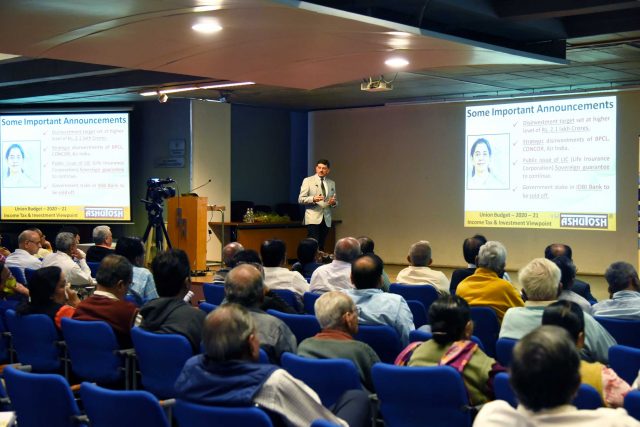
On 8th February 2020, the firm held its 15th annual budget presentation, titled “Union Budget 2020-21 – Income Tax & Investment Viewpoint,” across two sessions in Rajkot and Ahmedabad. The session was addressed by Daxesh Kothari and was designed for high-net-worth individuals, a group whose financial decisions often span multiple asset classes, cross-border income, and complex tax structures, all of which the Budget touches directly. For this audience, understanding not just what changed but why it changed carries real weight when planning investments for the year ahead.
The session opened by placing the Budget in context, walking through the state of the Indian economy at the time. GDP growth had slowed from 8.3 percent in 2016-17 to an estimated 5 percent in 2019-20, even as India remained among the fastest-growing large economies globally and held its position as the world’s fifth-largest economy by GDP. The presentation also touched on inflation trending upward, interest rates on a gradual decline, and a healthy build-up in foreign exchange reserves. A useful comparison of India’s stock market performance against twenty major global markets showed the Sensex delivering a respectable, though not exceptional, gain over the preceding year, with the rally still concentrated in a narrow set of stocks rather than broad-based. Government finances, meanwhile, were shown to be under pressure, with GST collections falling short of targets and disinvestment proceeds lagging expectations, a backdrop that shaped much of what followed in the Budget itself.
The heart of the session was the changes introduced to the Income Tax Act, and this is where the practical value for attendees became clearest. The Budget introduced a new, optional concessional tax regime under Section 115BAC, offering lower slab rates in exchange for giving up commonly used deductions such as those under Section 80C, HRA, and standard deduction. This meant individuals now had to actually compare their existing deductions against the new lower rates to see which structure suited them better, rather than assuming the new regime was automatically beneficial.
Equally significant was the shift in how dividend income is taxed. Previously, companies and mutual funds paid a dividend distribution tax before paying out dividends, making the income tax-free in investors’ hands. From April 2020, this shifted so dividends became taxable in the hands of the recipient at their applicable slab rate, with tax deducted at source. For HNI investors holding meaningful equity and mutual fund portfolios, this represented a real change in post-tax returns and made dividend planning something worth revisiting.
The rules determining residential status for Non-Resident Indians were also revised, with the criteria for who qualifies as a resident, and the newly introduced “Resident but Not Ordinarily Resident” category, tightened. This had direct implications for NRIs and those with income linked to overseas business interests, since it affects how much of their global income becomes taxable in India.
The session also covered the Vivad Se Vishwas scheme, a dispute resolution window allowing taxpayers with pending income tax litigation to settle by paying the disputed tax amount with reduced or waived penalties and interest, along with expanded provisions for tax collection at source on foreign remittances and large domestic transactions, changes to capital gains valuation for older property holdings, and a revised, higher tax audit threshold for businesses conducting most transactions digitally.
What came through across the session was that this Budget asked investors to actively reassess familiar assumptions, from which tax regime to choose to how dividend income and NRI status would now be treated, rather than simply continue with existing arrangements. Sessions like this one reflect why Ashutosh Financial Services continues to prioritise these annual discussions: financial regulations evolve every year, and staying genuinely informed remains one of the most practical steps toward making sound, considered financial decisions. It is a commitment the firm intends to carry forward in the sessions still to come.