For most non-resident Indians, the trickiest part of managing money across two countries isn’t earning it — it’s knowing where and how it gets taxed. Ashutosh Financial Services has long held that sound financial decisions start with clear information, which is why the firm regularly brings together practicing professionals to walk NRIs through the rules that actually govern their money, rather than leaving them to piece it together from forum posts and half-remembered advice from relatives.
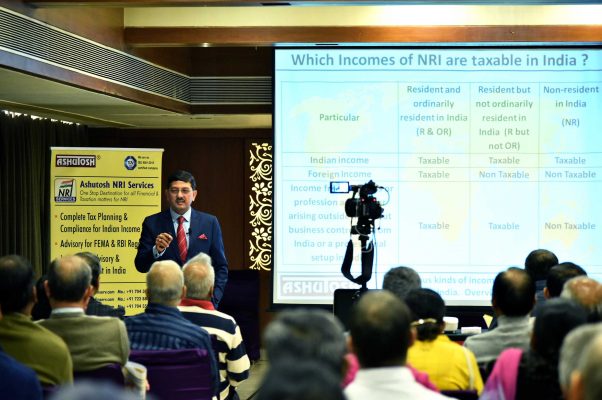
That was the spirit behind “Various Kinds of Income by NRI and its Tax Implications in India: Overview of FATCA, FBAR & CRS,” held in Rajkot on 29th January 2019 for an audience of NRIs. Chartered accountant Daxesh Kothari led the session, and the subject matter was chosen deliberately: NRIs sit at the intersection of two tax systems, and getting the interaction wrong — even innocently — can mean double taxation, compliance notices, or missed exemptions.
The session opened with the basics of residential status, since almost everything else in Indian taxation flows from it. Under Section 6(1) of the Income Tax Act, a person is generally treated as a resident if they spend 182 days or more in India in a financial year, though the rule tightens for those with substantial ties abroad. Residents are then split further into “Resident and Ordinarily Resident” and “Resident but Not Ordinarily Resident,” a distinction that matters because only the first category is taxed on worldwide income. Non-residents, by contrast, are taxed only on income that is earned or received in India — a foreign salary or foreign rental income stays outside India’s tax net.
From there, the discussion moved into what happens when income touches two countries at once. This is where the Double Taxation Avoidance Agreement, or DTAA, comes in. India has such agreements with close to 90 countries, and their purpose is straightforward: to stop the same rupee of income from being taxed twice, once in the country where it’s earned and again in the country where the person lives. Kothari explained the two broad approaches tax systems use — the residence rule, which taxes people on their global income regardless of where it was earned, and the source rule, which taxes income based on where it was generated. A DTAA reconciles the two through relief mechanisms: bilateral relief under Section 90 where a treaty exists, and unilateral relief under Section 91 where it doesn’t, so that tax already paid abroad can usually be credited rather than paid twice.
A particularly useful part of the session dealt with people who end up tax resident in more than one country at the same time — a common scenario for NRIs holding a US Green Card or meeting the American Substantial Presence Test while also qualifying as an Indian resident. In such cases, a “tie-breaker” test in the relevant treaty steps in, generally looking first at where the person’s permanent home is, then their centre of vital interests, then habitual place of stay, before falling back on nationality.
The event also worked through a detailed, income-by-income breakdown of how salaries, rental income, business income, capital gains on property and listed shares, and mutual fund gains are taxed for NRIs, along with the applicable TDS rates and the surcharge and cess additions at higher income levels. Alongside this, attendees learned which income categories are fully exempt from tax and TDS altogether, such as interest on NRE and PPF accounts, agricultural income, and profit shares from a partnership firm.
Compliance topics rounded out the session, including how PAN and Aadhaar requirements apply differently to NRIs, the role of a “representative assessee” who can be held responsible for a non-resident’s tax matters in India, and practical planning tools such as Section 80C and 80D deductions, capital gains exemptions under Sections 54 and 54-EC, and the tax-free transfer of NRO balances to NRE or FCNR accounts within the annual USD 1 million repatriation limit. The session closed with an overview of FATCA, FBAR, and CRS — the reporting frameworks that require foreign financial institutions and taxpayers themselves to disclose overseas accounts and assets, illustrated through a real-world case study on how NRIs structure investments in India while staying compliant on both sides.
Sessions like this reflect a simple belief: NRIs manage their finances well when they understand the rules well. Ashutosh Financial Services continues to organise these educational conversations so that individuals navigating cross-border finances have a clearer, more confident starting point for their own decisions.