A portfolio built only on habit rarely survives a changing economy. That belief is why Ashutosh Financial Services continues to bring investors face to face with the shifts shaping their money, rather than leaving them to piece it together on their own. The organisation’s ongoing calendar of financial awareness sessions rests on a simple conviction: sound decisions are made when people understand the “why” behind an investment, not just the “what.”
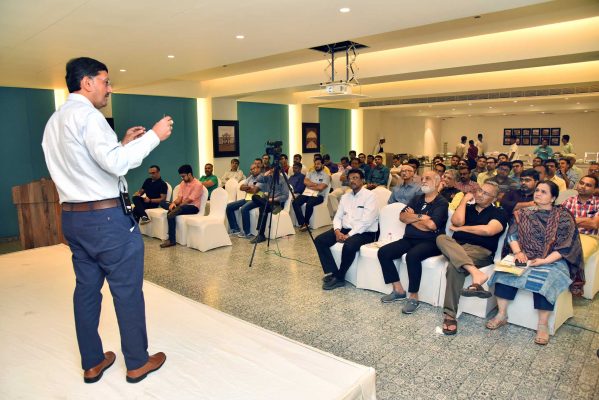
This thinking shaped “Road Ahead for Investment, Equity, Fixed Income, Real Estate & Unit Linked Insurance,” held in Rajkot on 13th November 2019 for an audience of high net worth individuals. The session was led by Daxesh D. Kothari, who walked attendees through the major asset classes available to Indian investors and the economic backdrop against which each of them was set to perform. For an audience already holding diversified portfolios, the value lay less in introducing new products and more in helping them read the changing environment correctly.
The session opened with the economic undercurrents of the time. India’s GDP growth had come under pressure, even as the country remained among the fastest-growing large economies in the world, with festive-season demand offering early signs of a pickup. The discussion connected this to fiscal realities: a cut in corporate tax rates aimed at reviving growth, GST collections running below expectations, and the government’s search for funding through routes such as strategic disinvestment. Liquidity conditions were examined too, with several public sector banks placed under the Reserve Bank’s Prompt Corrective Action framework and a number of non-banking finance companies under stress, even as well-run lenders continued to find ample liquidity for sound borrowers. GST and demonetisation were framed as measures gradually shrinking the parallel economy and pushing India toward better compliance, changes that carry real consequences for how individuals plan their investments and disclosures.
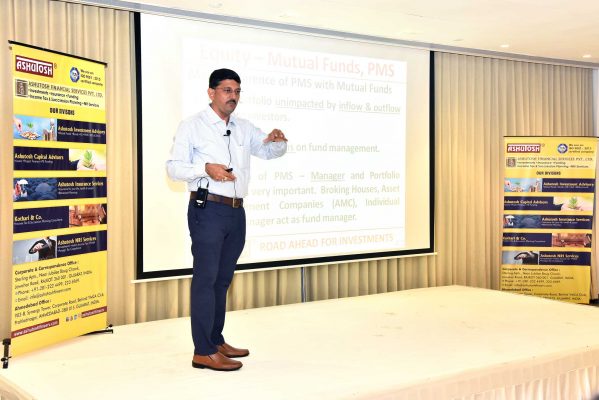
On equity, the session explained how the Securities and Exchange Board of India’s fund categorisation rules now require every mutual fund house to classify schemes clearly as equity, hybrid, or debt oriented, giving investors a consistent way to compare products across fund houses. Attendees were taken through the resulting fund types, from large-cap and multi-cap funds to sectoral, thematic, and international options, along with hybrid categories that blend equity and debt in varying proportions to suit different risk appetites. The case for diversification extended beyond India, with a specific pointer toward mutual funds investing in US markets, given the scale of American companies as global businesses. Portfolio Management Services were also covered as an alternative for larger allocations, distinguished from mutual funds by individualised holdings and a higher minimum investment threshold.
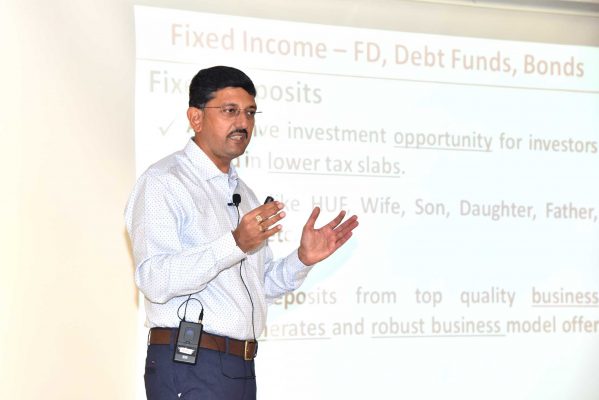
Fixed income received equally close attention. The session compared traditional fixed deposits with debt mutual funds and highlighted tax-free bonds issued by government undertakings, using a worked comparison to show how their post-tax yield could outperform bank fixed deposits for investors in higher tax brackets. Perpetual bonds were introduced as a higher-yielding but higher-risk category, given their embedded call options and the possibility of missed interest payments in a weak year.
Real estate was discussed through the lens of India’s expanding infrastructure, from new highway corridors to metro rail expansion, and how this is gradually reshaping demand across cities, alongside the tightening effect of RERA and reduced funding availability on the broader market. The session closed with a segment on Unit Linked Insurance Plans and a set of practical income tax pointers, including rules around gifts, interest-free loans within the family, and the disallowance of expenses linked to tax-free income.
Throughout, the underlying message was less about chasing returns and more about matching each asset class to the investor’s temperament and needs, whether that meant the discipline required to stay invested through equity volatility or the comfort that fixed income can offer during uncertain times. Sessions like this reflect why Ashutosh Financial Services keeps investing in financial literacy: markets and regulations will keep changing, and investors who understand the reasoning behind their choices are better placed to navigate whatever comes next.