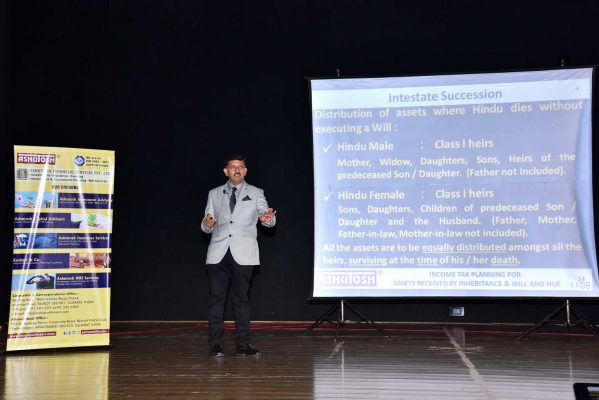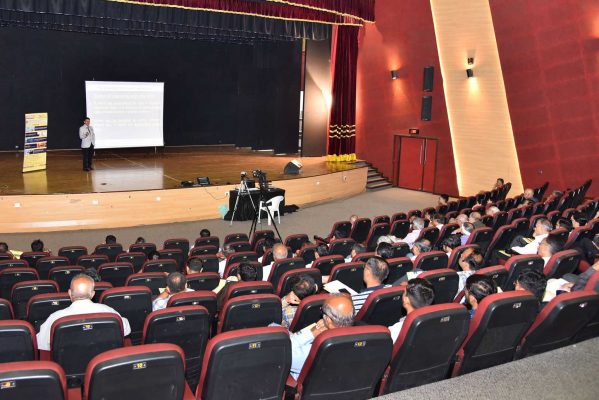
Estate planning rarely gets discussed until it becomes urgent, and by then, many of the choices that could have made the process simpler are no longer available. It was with this in mind that Ashutosh Financial Services organised a session for its high net-worth clients in Rajkot, built around a topic families often postpone: how assets pass on after death, and what the tax law has to say about it. Financial education, in the view of the firm, works best when it addresses the questions people are reluctant to ask out loud, and succession planning sits squarely in that category.
The session, titled “Income Tax Planning of Assets Received by Inheritance & Will and HUF,” was held in Rajkot on 28th September 2019 for an audience of high net-worth individuals. Daxesh Kothari led the discussion. For this audience, the subject carries particular weight. HNIs typically hold a mix of financial assets, property, and business interests across generations, and how those assets are structured can meaningfully affect what heirs eventually receive, both in value and in the ease of the transfer process.
The session opened by laying out how succession law actually works in India. When a person dies, their assets pass either through testamentary succession, where a valid Will exists, or intestate succession, where it does not. Which set of rules applies further depends on religion: the Hindu Succession Act governs Hindus, Sikhs, Jains and Buddhists; Muslim Shariat Law applies to Muslims; and the Indian Succession Act covers Christians and Parsis. Kothari walked through what makes a Will legally sound, from being in writing and clearly identifying the testator and beneficiaries, to bearing the signatures of two witnesses. He also touched on when a Will should be revised, such as after the death of a beneficiary, witness, or executor, and outlined the probate process by which a court certifies a Will as conclusive.
A recurring theme was the limited role of nominees and joint holders. Many people assume that naming a nominee on a bank account or investment settles the matter of ownership. The session clarified that a nominee is only a custodian of the asset, not its legal owner; the actual beneficiary is determined by the Will, or, in its absence, by the applicable succession law. Where no Will exists, legal heirs must instead obtain a Succession or Heirship Certificate from the court to establish their claim, a process that can take considerably longer than probate.
On the tax side, the session addressed Section 56(x) of the Income Tax Act, which taxes gifts and property received without adequate consideration above Rs. 50,000, but specifically exempts assets received from relatives, on marriage, or through inheritance or a Will. A natural follow-up question, since no upper limit is placed on inherited assets, is what happens with large sums received this way. Here Kothari brought in Section 68, which allows the tax department to treat unexplained credits as taxable income, at rates that can exceed 83% once penalties are added, if the recipient cannot establish the identity of the giver, their creditworthiness, and the genuineness of the transaction. This is a useful reminder that inheritance being tax-exempt does not eliminate the need for proper documentation.
The session then moved into planning strategies. A Will offers considerably more flexibility than intestate succession, since assets can be directed to HUFs, minors, or chosen individuals rather than only to legally defined heirs. One structure discussed was the discretionary family trust created under a Will, which is taxed as a separate entity at regular slab rates rather than the higher rate usually applied to discretionary trusts, while also being eligible for deductions such as Section 80C.
A substantial part of the session was devoted to the Hindu Undivided Family, or HUF, a structure unique to Hindu law. Kothari explained how HUFs are formed, who qualifies as a co-parcener following the 2005 amendment recognising daughters, and how partition and the role of Karta work. On taxation, the session distinguished between gifts from members, which are clubbed with the donor’s income, and gifts from non-members, which are taxable beyond Rs. 50,000 without any clubbing.
Sessions like this reflect a simple belief: financial security is not only about building wealth, but about ensuring it transitions smoothly to the next generation. Ashutosh Financial Services continues to organise such initiatives because informed decisions, particularly around matters families tend to avoid discussing, tend to serve everyone better in the long run.