Every financial decision an NRI makes in India — where to invest, how to bring money in, how to send it back out — is shaped by rules that most people never encounter until they need them. Ashutosh Financial Services runs regular sessions on exactly this kind of ground-level financial knowledge, working from a simple premise: sound financial decisions are only possible when people understand the framework they’re operating within, not just the products on offer.
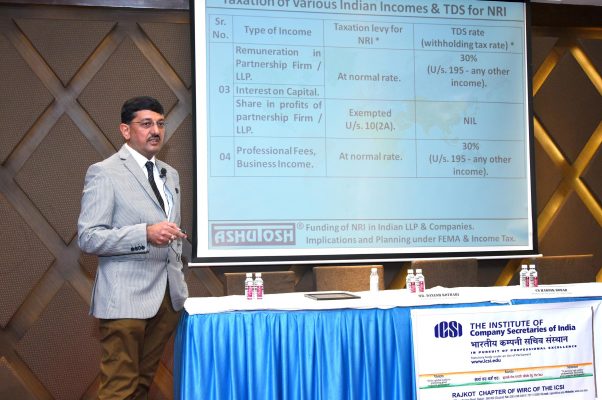
On 13th February 2019, the firm hosted a session in Rajkot titled “Funding of NRI in Indian LLP & Companies: Implications and Planning under FEMA & Income Tax.” The session was led by Daxesh Kothari and aimed squarely at the non-resident Indian community — professionals and businesspeople settled abroad who continue to hold financial ties to India, whether through family, property, or business interests. For this audience, the challenge is rarely a lack of capital. It’s the difficulty of knowing which Indian law applies to them, and when.
That difficulty was the session’s starting point. Kothari walked through how differently “NRI” is defined depending on which law you’re reading. Under the Income Tax Act, residency comes down to counting days spent in India during the year. Under FEMA, the Foreign Exchange Management Act that governs cross-border money movement, residency instead depends on intent and conduct — why someone left India and what their circumstances suggest about how long they plan to stay away. A separate test again applies to eligibility for an Overseas Citizen of India card, and yet another applies under the Citizenship Act itself. The practical point for attendees was that a person could be treated as resident under one law and non-resident under another, at the same time — so the correct classification always depends on which question is actually being asked.
From there, the session moved into how NRIs are taxed. It covered the two basic principles used worldwide — residence-based taxation, where a country taxes its residents on income earned anywhere, and source-based taxation, where a country taxes income earned within its own borders. India has Double Taxation Avoidance Agreements with more than 89 countries specifically to stop the same income being taxed twice under these overlapping principles, and Kothari explained how relief works in practice: where a treaty exists, the more favourable of the treaty rate or the local law applies; where it doesn’t, a taxpayer can still claim credit in India for tax already paid abroad, though only as a credit, never a refund.
A substantial part of the session dealt with how NRIs can actually put money to work in India. It covered the distinction between investing in an LLP or an unlisted company on a repatriable basis, where proceeds can eventually be sent back out of India, versus a non-repatriable basis, where they stay within the Indian banking system. This distinction determines which bank account — NRO, NRE, or FCNR — the funds should flow through, since each account type carries different rules on repatriation and taxation. The session also addressed lending: an NRI can lend to a close relative in foreign currency up to US$250,000 interest-free, or lend in rupees to any resident individual on non-repatriable terms, subject to caps on tenure and interest.
Gifting drew particular attention, since it sits at the intersection of two separate laws that don’t always move together. FEMA permits an NRI to gift money to a resident from their NRO or NRE account, or even hand over cash within a modest limit. Separately, under the Income Tax Act, a gift becomes taxable in the recipient’s hands once it crosses Rs. 50,000 in a year, unless it comes from a relative as narrowly defined by the Act. Even where a gift qualifies for that exemption, the recipient may still need to satisfy a different provision — Section 68 — by proving the identity, creditworthiness, and genuineness of the giver, since an unexplained credit can otherwise be treated as taxable income at a very high effective rate.
The session closed with a detailed look at how specific streams of Indian income are taxed for NRIs — rent, partnership income, capital gains on shares and property, professional fees — along with the applicable TDS rates, and the mechanics of moving funds from an NRO to an NRE account once due taxes have been settled.
Sessions like this reflect a straightforward belief: navigating the space between two countries’ financial systems shouldn’t require guesswork. Ashutosh Financial Services will continue to bring this kind of grounded, practical guidance to the communities it serves, one session at a time.