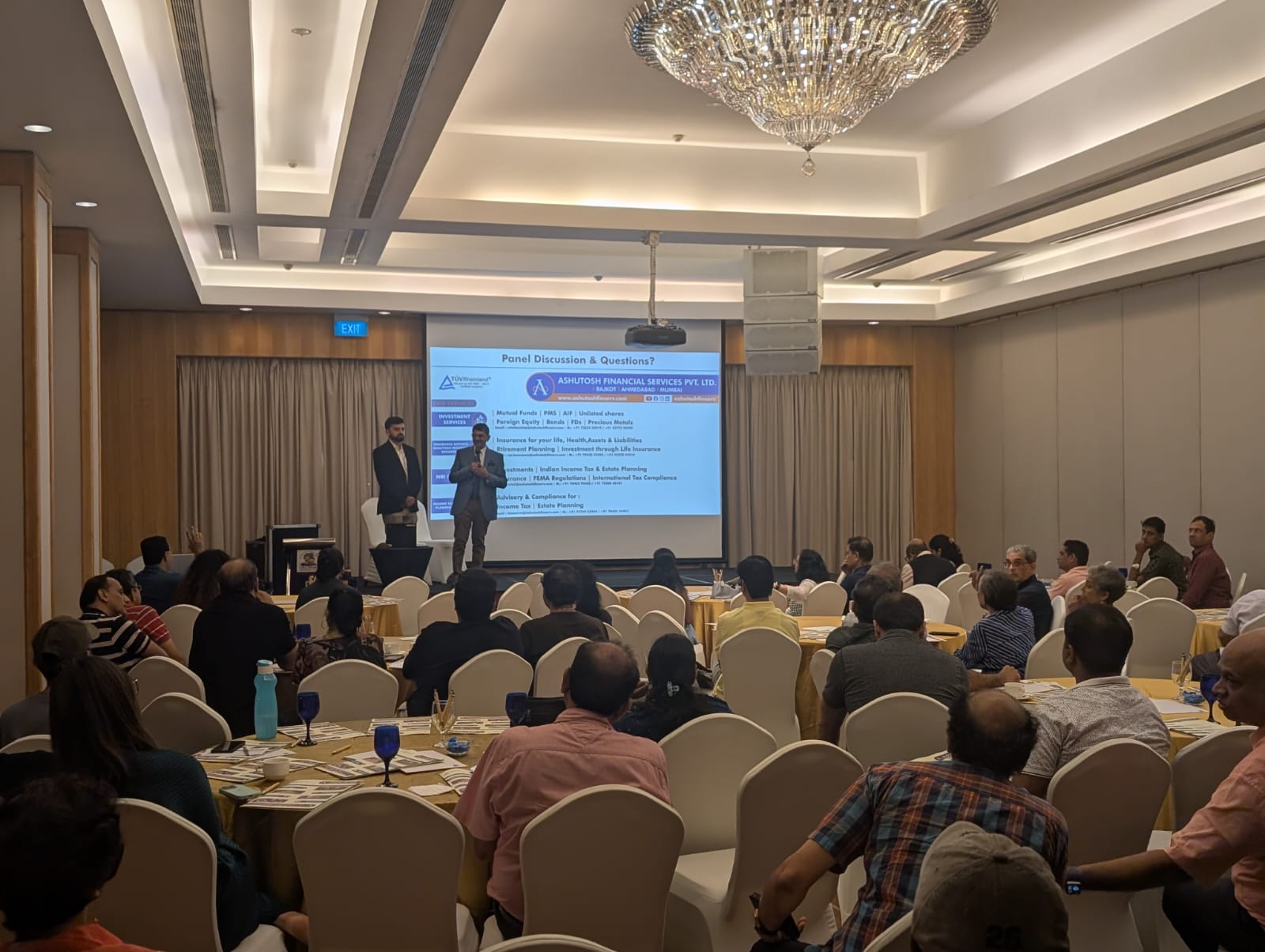
Singapore’s Indian diaspora has always faced a peculiar challenge: staying financially connected to a home country whose rules keep shifting, even while building a life thousands of miles away. It was with this reality in mind that Ashutosh Financial Services organised a financial awareness session in Singapore on 23rd November 2024, part of its ongoing effort to help Non-Resident Indians make sense of a regulatory landscape that rarely stands still. The company has long held that sound financial decisions start with clear information, and this session, titled “Changing Landscape of Taxation, Regulations and Investments in India,” was built around that belief.
The event brought together NRIs based in Singapore and was led by Daxesh Kothari and CA CFP Rajit Kothari, both speaking from years of hands-on experience guiding overseas Indians through cross-border financial matters. Given how often banking rules, tax obligations, and investment options change for NRIs, a session that consolidated the latest developments was particularly timely for an audience juggling two financial systems at once.
The discussion opened with the fundamentals of NRI banking. Under India’s foreign exchange regulations, a person who becomes an NRI cannot continue holding a resident savings account; it must be converted to an NRO account or closed. From there, the speakers walked through the four main account types available to NRIs, each serving a different purpose. The NRO account holds non-repatriable rupee funds and is taxable, while the NRE account holds repatriable rupee funds and enjoys tax exemption. The FCNR account allows deposits in foreign currency with similarly tax-free income, and the RFC account rounds out the options. A useful clarification for many attendees was around moving money from an NRO account to an NRE account or abroad: NRIs can transfer up to USD 1 million per year, provided applicable taxes are paid and a simple certification process is followed, though this limit doesn’t apply to current income like rent or dividends, which can be transferred without restriction.
Identity documentation was another area covered in some depth. A PAN card, the session explained, is required for activities ranging from opening a bank account to purchasing property or investing in mutual funds, while Aadhaar, interestingly, is not something NRIs are eligible to obtain, which also exempts them from any requirement to link it with their PAN.
On taxation specifically, the speakers explained how Singapore tax residents can choose whichever framework works in their favour, either Indian domestic tax law or the India-Singapore Double Taxation Avoidance Agreement, whichever gives a better outcome. This choice affects withholding tax rates significantly across income types like dividends, interest, and capital gains from shares, mutual funds, or property. To actually benefit from the lower DTAA rates, NRIs need to obtain a Certificate of Residence from Singapore’s tax authority and file Form 10F with India’s income tax department, a process the session walked through step by step.
Estate matters received equal attention, since transmission of a deceased NRI’s Indian assets follows Indian succession law, not Singapore’s. Whether that means the Hindu Succession Act, Muslim Shariat Law, or the Indian Succession Act depends on the deceased’s religion and whether a Will was made. A point the speakers emphasised was that nominating someone on an account doesn’t make that person the legal owner; a nominee is merely a custodian until the assets pass to the rightful heir under succession law. Wills can be validly prepared outside India, ideally signed before a notary with two witnesses.
The session then turned to opportunity, framing India’s economic momentum through comparative data: growth projections outpacing most major economies, a stock market ranking among the world’s largest by market capitalisation, and a young, English-speaking workforce. Against this backdrop, the speakers outlined practical routes for NRIs to participate, from mutual funds and portfolio management services to unlisted shares and alternative investment funds, each carrying different minimum investment sizes, liquidity profiles, and recommended time horizons. A dedicated segment also introduced GIFT City, India’s international financial services centre, where NRIs can invest in USD-denominated alternative investment funds without needing an Indian bank or demat account, and where gains on such investments carry no Indian tax implications.
Sessions like this reflect a simple conviction: that NRIs navigating two financial systems deserve access to accurate, current information rather than assumptions or outdated advice. As India’s regulatory and investment environment continues to evolve, Ashutosh Financial Services remains committed to bringing these updates directly to the communities they affect, one conversation at a time.