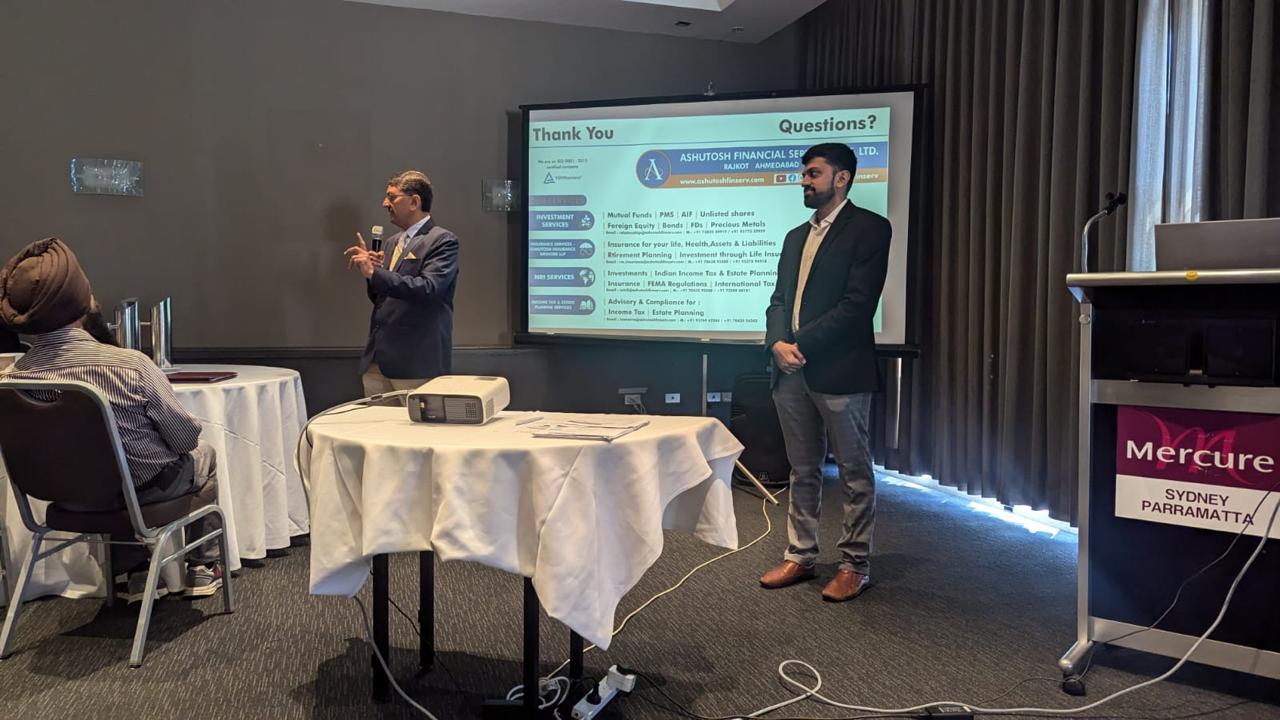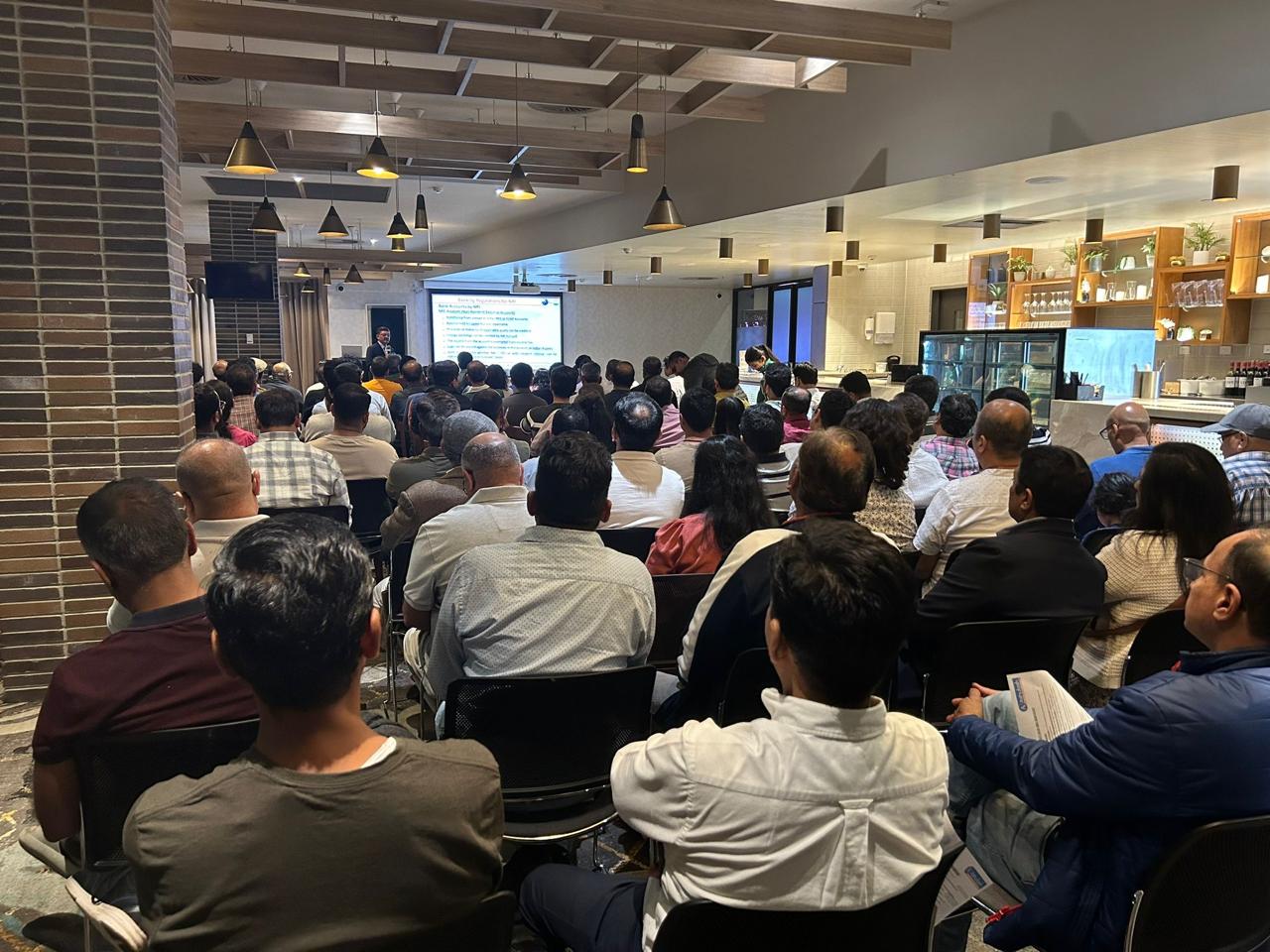
Ashutosh Financial Services regularly organises sessions like this one because navigating money matters across two countries is rarely straightforward, and the team believes that clarity on rules and options is the first step toward confident financial decisions. For Indians who have settled abroad, questions about taxation, banking, and investing back home tend to pile up quietly over the years, often without a clear place to get them answered. It was with this in mind that the session titled “Financial Awareness Presentations for Australian NRIs” was held on 17th September 2024 in Australia, bringing together Non-Resident Indians for a closer look at how India’s financial and regulatory landscape affects them. The session was led by Daxesh Kothari and CA CFP Rajit Kothari, who walked attendees through a wide-ranging set of topics that touched nearly every corner of an NRI’s financial life in India, from bank accounts to inheritance planning to fresh investment opportunities.
The discussion opened with the basics of banking regulations, an area that trips up many NRIs simply because the rules change the moment residency status changes. Under India’s foreign exchange law (FEMA), a person who becomes an NRI can no longer hold a regular resident savings account and must convert it into an NRO account instead. The session explained the four main account types available to NRIs: the NRO account, which holds non-repatriable rupee funds and is used for India-based income such as rent or dividends; the NRE account, which holds repatriable funds remitted from abroad and offers tax-free interest; the FCNR account, which allows deposits in foreign currency and also carries tax-exempt income; and the RFC account, relevant mainly for returning residents. A practical point that came up was the ability to transfer money from an NRO account to an NRE account or abroad, up to a limit of one million US dollars per year, provided due taxes have been paid and a simple certification process is followed. This limit can even be extended with the Reserve Bank of India’s permission in genuine cases of inherited assets.
From there, the session moved into documentation requirements that often cause confusion. A Permanent Account Number, or PAN, turns out to be necessary for almost any meaningful financial activity in India, whether that’s opening a bank account, buying property, investing in mutual funds, or even purchasing a vehicle. Interestingly, NRIs are not eligible for an Aadhaar card at all, and are fully exempt from producing one for verification purposes, though anyone who already holds an Aadhaar card is expected to link it with their PAN. The presentation also clarified who is required to file an income tax return in India, noting that this obligation kicks in not just based on income levels but also based on certain high-value transactions, such as depositing more than fifty lakh rupees in savings accounts or spending more than two lakh rupees on foreign travel from an Indian account in a year.
A recurring theme through the session was the question of double taxation, which naturally worries many NRIs earning income in two countries. The speakers explained the difference between the residence rule, under which Australia taxes an NRI’s global income, and the source rule, under which India taxes income earned within its borders. The Double Taxation Avoidance Agreement between India and Australia exists precisely to prevent the same income from being taxed twice, and it also offers concessional rates on certain types of Indian income like dividends and interest.
Succession and estate planning received considerable attention too, an area that’s easy to overlook until it becomes urgent. The presentation clarified that assets in India are transmitted according to Indian succession laws, which vary by religion, Hindu Succession Act, Muslim Shariat Law, or the Indian Succession Act for Christians and Parsis, and depend on whether the person left a valid will. A useful clarification was that nominating someone on a bank account or investment doesn’t make that person the legal owner; a nominee is only a custodian, while actual ownership passes according to succession law or a will. On that note, the session confirmed that a valid will for Indian assets can be prepared entirely outside India, signed before a Notary Public along with two witnesses, without needing to travel back.
The latter part of the session turned optimistic, framing India as a genuinely resurgent economy worth participating in. Data shared showed India posting a 6.8% growth rate for 2024, ahead of every other major economy including the US and Australia, alongside strong stock market performance and a young, large workforce driving consumption. Various routes for NRI investment were discussed, including direct equity, mutual funds through SIPs, portfolio management services for larger portfolios, and even carefully selected unlisted shares, illustrated through the real example of Tata Technologies, which delivered a 72.65% CAGR between 2021 and its 2023 listing. The speakers also introduced GIFT City in Gujarat, India’s first International Financial Services Centre, which allows NRIs to invest in Category III Alternative Investment Funds in US dollars without needing an Indian PAN, bank account, or tax filing, a notably simplified route for those wanting exposure to Indian markets without added compliance.
Sessions like this reflect a simple belief: that financial confidence comes from understanding, not guesswork, particularly when two countries’ rules intersect. Ashutosh Financial Services continues to organise these conversations because staying informed about changing regulations and opportunities is an ongoing need for the NRI community, not a one-time exercise, and the team remains committed to supporting that journey through regular educational engagement.